Soul and Song – Chapter 15

Aluanna awoke at dawn the next morning, as she did nearly every day of her life. It seemed somehow wrong to her to allow the sun to rise without her greeting it. She had only had a few hours of sleep the night before, but her mind was alert, and her senses clear. As usual, she would find time to clear away the rest of her weariness later in the day with a late afternoon nap. It was a habit she had inherited from her mother.

Though Aluanna had stayed awake long into the night, she knew she had retired much earlier than the majority of her band. The satyr triplets in particular always stayed awake nearly the entire night, playing their music to keep the dark forces of the forest away. She was grateful for their cheerfulness and strength, but she wondered if anyone in the band knew just how tenuous and fragile their hold on the forest really was.

Her band was loyal, but their numbers were not great. Members of her band came and went as they pleased. None were obligated to stay indefinitely, and many would come and go depending on the season, individual needs, or just on personal whims. In the last couple of years, her band had never been smaller than twenty musicians, but it also never grew much larger than fifty members at one time. How many henchmen did the enemy have at his disposal? A hundred? A thousand? It was impossible to know for sure, but Aluanna was certain that she and her loyal followers were far outmatched.

So why hadn’t they been wiped out already? Did the enemy really fear some kind of power she possessed? Or was he just playing with her because he knew he could finish them off whenever he wanted? Whatever the answer, Aluanna told herself that she had to remain confident and strong in front of the others. If any of them guessed at the fear she kept to herself, the entire band would fall apart overnight. And she was certain that her woods would be far worse off if that happened.

Aluanna looked across the clearing and saw the tall dark-skinned man her band had rescued the night before. He was one of the few people also awake already, and although he was obviously still exhausted from his encounter with the vampire, his back was straight and his expression was determined. There was something about his countenance that gave her pause, though she couldn’t quite place what it was.

Huddled in a large sleeping bag near the ashes of the campfire was the pale, bald young man that had also encountered Laronius. He was so pale and cold when they found him that she was surprised he had survived the experience. As Aluanna watched him sleep, she noticed with some puzzlement that he slept in his sleeping bag with his traveling cloak still on, and the hood pulled up over his head. Perhaps it was the only way to keep such a bald head warm in the night?

It was clear to Aluanna that the young man had powerful magic within him. One of her gifts was that she had always been able to sense the magic in others. She considered the talent a gift from her father, and it was one of the ways she had been able to gather together a band such as hers, where so many had unique gifts to contribute, like the satyr triplets. Aluanna suspected that the young man had little understanding of how to use his magic, but his potential was unmistakable.

And then there was the other man that had been with them. The one with light brown hair and eager eyes like a wolf pup. Aluanna didn’t know what to think of him at all. His story was unbelievable, but his every word was so sincere it was heartbreaking. He certainly didn’t have the confidence and strength of his dark-skinned friend, yet he seemed every bit as determined. He was not self-assured, but he was sure of… something. More than once when Aluanna had been falling asleep, she had asked herself what could drive him this way if his story wasn’t authentic.

Even stranger than the man’s demeanor was the curious sensation Aluanna had experienced while feeling the magic surrounding him.

Aluanna had always struggled to describe to others what it was like to sense magic in others. They always wanted her to describe it in terms of sights or sounds or physical touch, but that was about as useful as trying to explain the color of an itch or the sound of bitterness. The closest she could come to helping others understand was comparing it to the undefinable sensations one felt in different weather.

Most people felt like a calm overcast day, like there was nothing out of the ordinary to notice. Those with powerful magic, like the bald young man, made Aluanna’s breath shift rhythm and her skin tingle just below the surface, as if a thunderstorm was approaching. But the man with brown hair was different. Sensing him felt like there was some strange, clear pull coming from somewhere not quite behind her and moving upwards, like standing on a high, wind-swept mountain where the air just seems to disappear above you.

Aluanna didn’t believe everything he had said the night before about his quest and who it came from, but she couldn’t deny that there were things about him that left her intuition abnormally unsure.

Who were these three men? What were they really doing here in a forest plagued with the supernatural, and why hadn’t they been killed by Laronius? Others had come along in the past who would join her band and take up her fight against the necromancer, but ultimately they merely added to the strength of her fight. She knew that if she fell or gave up, the rest of the band would leave the fight within days.

These three seemed to bring a new fight all their own. The thought that there were others who could make a difference if she were gone was both a relief, and a concern. She did not know these men, and they did not answer to her, and even if their intentions were good, their disruption could shatter the semblance of balance she had fought so hard to maintain.

Aluanna was pulled from her thoughts as she heard the patter of raindrops on leaves a moment before the drops made their way to the forest floor. As quickly as dignity would allow her, she hurried back to her tent to put on her hooded traveling cloak. She may be attuned to nature as the Lord of the Forest’s daughter, but that didn’t make her immune to wet hair.

***

“Where’d this awful rain come from?” Shon spluttered as he tried to wipe large droplets from the top of his bald head. He was still recovering from the rather rude awakening of water falling on his face, followed by stepping in a puddle in his rush to stand up and put his boots on.

“I think it usually comes from the sky, Sir Soggy Socks,” said Roj, and the short satyr bleated a loud laugh.

Shon fumed at the sarcastic remark, but suppressed an angry retort that could cost him his spot under the canopy that some of Aluanna’s band had quickly assembled to stay dry. It was clear to Shon that many of the others standing under the canvas covering were feeling frustrated about the unexpected rain, but none of them had gotten nearly as upset as he had. After taking a moment to calm down, Shon said, “What I mean is, I didn’t even see any clouds last night. How could a rain storm just start up out of nowhere?”

“I would hardly call this a storm,” said Soj as he tipped his tall head under the canopy to join them. “This is just a normal early autumn shower. It may have come along a couple weeks before we expected, but it’s nothing out of the ordinary. And I suspect we’ll be seeing a lot more of them in the next several months.”

“Several months?” moaned Shon. “How many months can rain keep going for?” The prospect of rain continually pouring from the sky nonstop for months on end filled Shon with a dread hopelessness that seemed to suck all the heat and happiness right out of him, right through the bottom of his wet foot.

As if sensing this, Roj spoke up again. “Relax, Sir Soggy Socks. My brother doesn’t mean you’ll never see a dry day again until spring. He just means you ought’a get used to it because a lot more rainy days are on their way.

Just then, Tarun and Seth stepped under the canopy and out of the rain. “We got the flaps all tied down on the wagon,” said Seth, “but I’m afraid quite a bit of water got in already, and most of your clothes got wet.”

“Well that’s just great!” shouted Shon. Panic started to set in as he wondered if he would ever feel warm and dry again. “And who asked you to go messing with our tent anyway?”

“I did,” said Tarun. “It would’ve taken a lot longer with only one person doing it, and it would have gone even quicker if there had been three.”

Shon felt his face go hot red as Tarun’s words sunk in. Shon had been so frantic about finding shelter when he woke up that he didn’t even think to go help Tarun with the wagon and their supplies.

Then he remembered something, and he smacked himself on the forehead in supreme embarrassment and frustration. “Oh no! I forgot to pick up my sleeping bag. It’s still lying in the mud!!”

“I, uh, noticed that,” Seth said quietly. “I grabbed it and threw it into the wagon before we started tying it down.”

“Oh,” said Shon. “Thanks.”

For a while, everyone was quiet around them, and the only sound was the raindrops hitting the canvas above them. Shon turned to Seth to apologize, but he never got the chance to start. Toj had just walked under the canopy and he was looking much more serious than his two brothers. The satyr gestured to Shon, Tarun, and Seth and made a jerking motion with his horned head.

“You three had better come with me,” said Toj. “Lady Aluanna would like a word with you.”
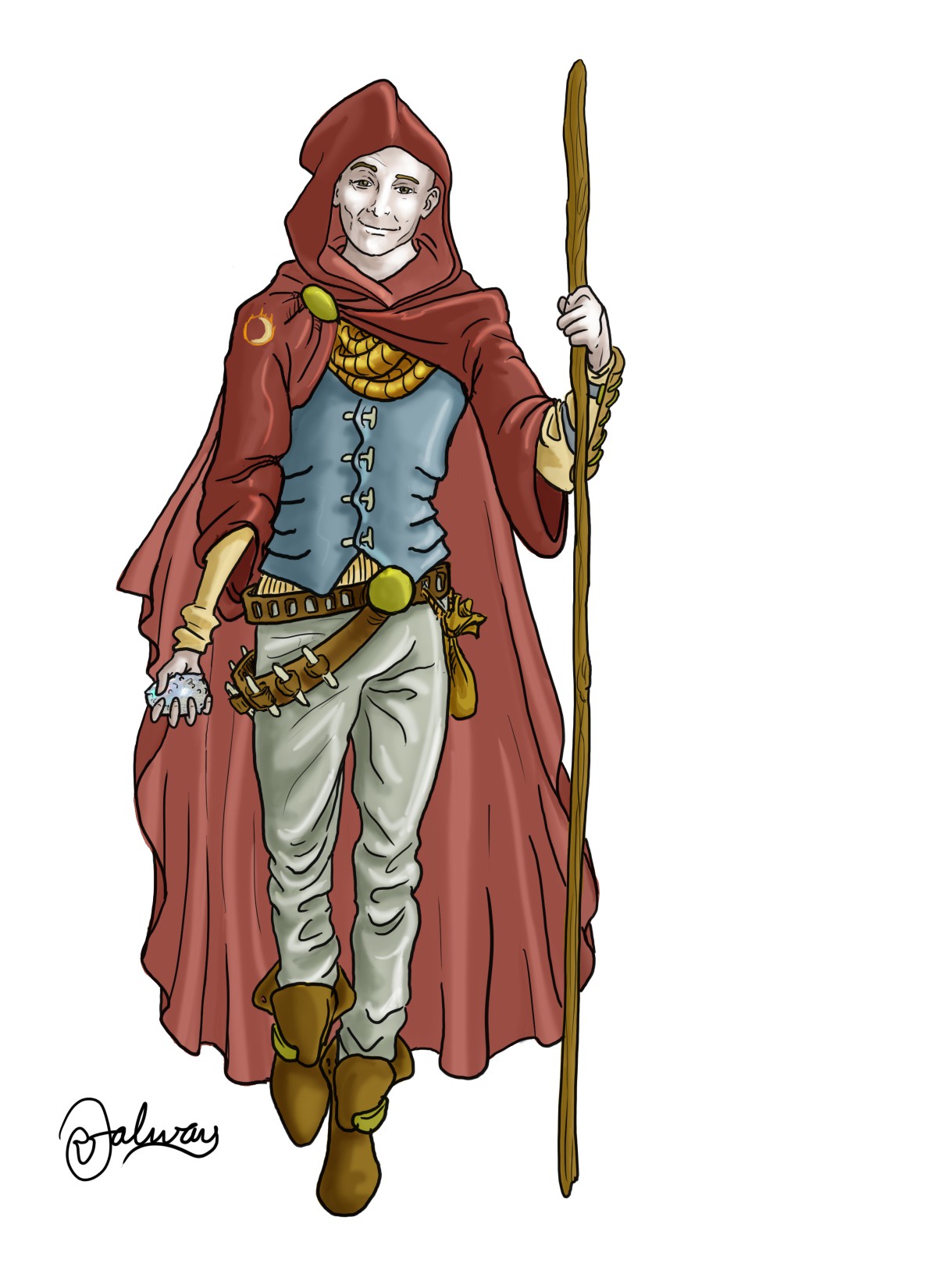
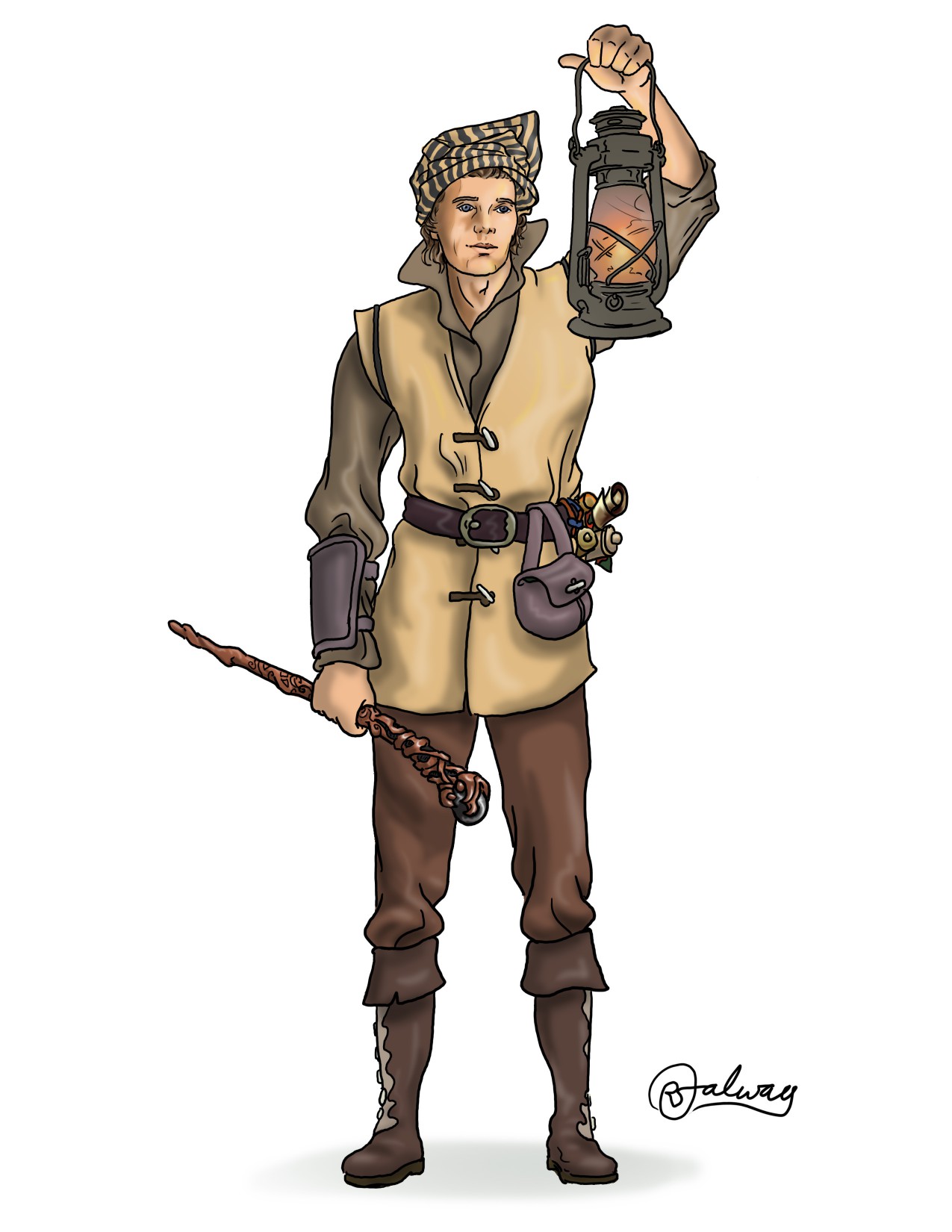
Illustration of Shon by Ryan Salway
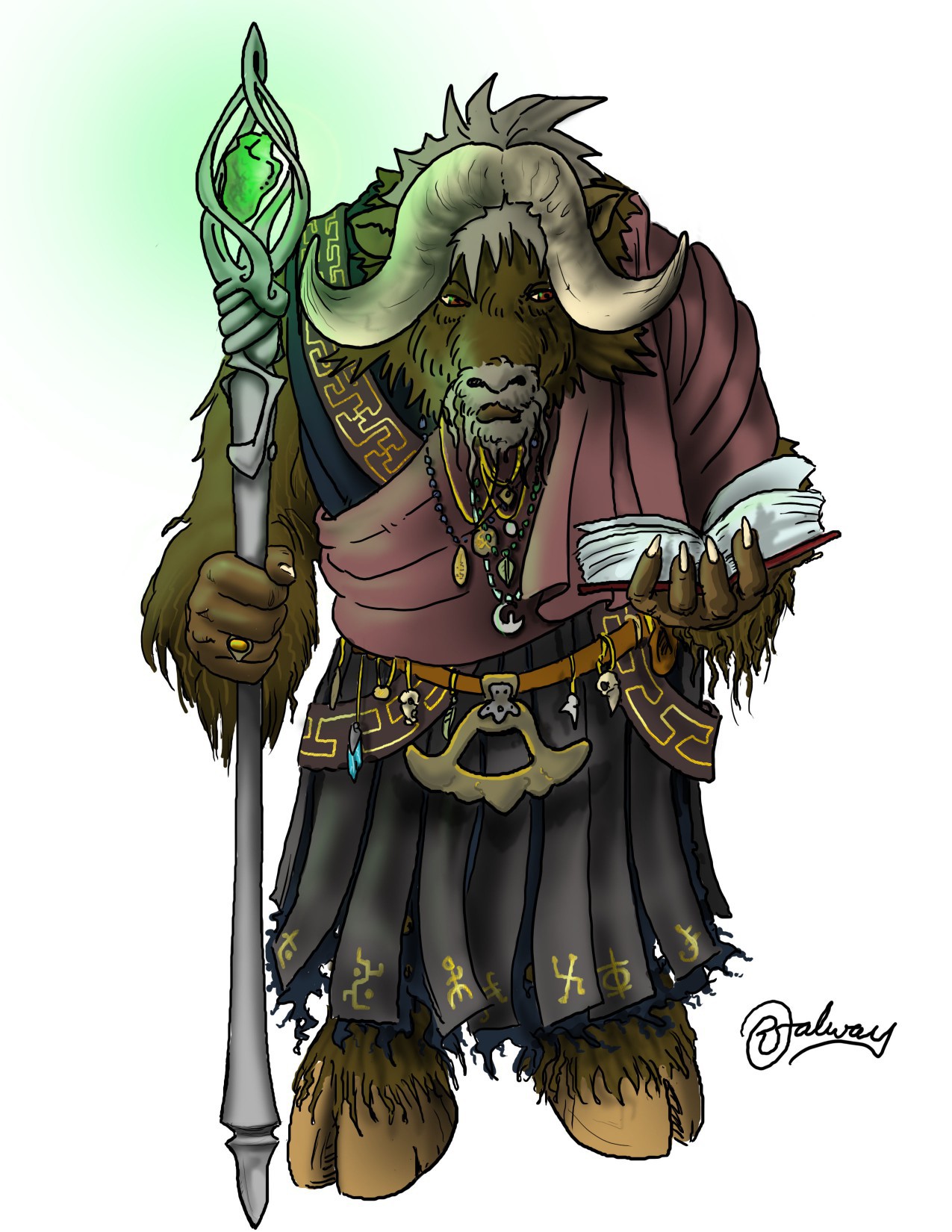
Illustration of Shon
by Ryan Salway
 

Soul and Song – Chapter 14

Vdekshi sat cross-legged in his meditation chamber, his eyes closed. A low constant hum emanated from his throat, out his bovine nostrils, and reverberated against the bare stone walls of the room. A small bowl sat in front of him with two sticks of incense burning inside. One stick produced a thin stream of light purple smoke as it burned, and produced a sweet, earthy scent that evoked images of springtime hillsides and freshly fallen rain. Black smoke trailed from the other burning stick, bringing with it a stinging, spicy odor of fire and metal and ash.

With each deep breath Vdekshi inhaled, he imagined each trail of smoke rushing into separate nostrils. He would then hold his breath for a moment, envisioning the two colors of smoke swirling and mixing within his lungs. He would then focus on using his humming to transform the smoke mixture into a golden energy that bounced off every surface like ripples in a pond until settling in his ears. After running out of breath, he would begin the process all over again.

Vdekshi had learned the technique as a young monk early in his training at the monastery. While the exercise had not cured his youthful impatience, it had certainly tempered it. Many years ago, one of his instructors had begun a similar meditation while a nearby caterpillar was weaving its cocoon, and the elderly monk had not opened his eyes again until the moment it had emerged as a butterfly. Vdekshi had asked his teacher what he had hoped to gain from such an experience.

“Nothing at all,” the old monk had told him. “If I was trying to gain something, I never would have succeeded.”

Vdekshi contemplated the memory as he continued the exercise in his chamber. He wanted so desperately to want nothing, but there were far too many pressing matters that required his attention. He had to keep his supernatural servants active enough that they could be called upon at a moment’s notice, but he also had to restrain them enough that they did not devour or drive off the entire nearby mortal population. Maintaining such a delicate balancing act was exhausting, and Vdekshi longed for a momentary respite.

Vdekshi sought peace and acceptance of the fact that the incompetence of Laronius and his other servants had led to the escape of his prized dragon test subject. The memory of that event still evoked aggravation and annoyance that Vdekshi couldn’t seem to suppress. After all, the experiment had shown significant promise, and starting over from scratch was a frustrating prospect.

As always, there was the lingering guilt and disgust that Vdekshi felt after a necessary treatment for his… condition. He had accepted the fact decades ago that such sacrifices were necessary for the greater good, but he hoped that the meditation would remove any residual remorse. At most, the solitude offered him an opportunity to review his justifications for the deaths he caused.

And now there was a new concern on Vdekshi’s already troubled mind. It was obvious that his old servant Krall had been poisoned by his dragon while on the loose, but the blood in his body had been untainted. How? How could a simple orc figure out the answer that Vdekshi had been searching for all these years? What did these strangers he traveled with have to do with it, and why were they in his land? And why was it taking so long to get them here in his fortress where he could ask them these questions himself?

The longer that Vdekshi pondered on these questions, the more frustratingly elusive the answers seemed to be, and the more agitated he became. It was not long before Vdekshi opened his bleary eyes and rose stiffly from the ground. He regularly tried to use the old ways he had been taught to find clarity and answers, but every time he came to the same conclusion that the old ways were not sufficient for the obstacles his life faced. Things were not as simple as they once were, and while simple humming may have been able to soothe his younger, happier self, he no longer had the luxury of being so carefree. Difficult days called for difficult decisions, and Vdekshi’s eyes turned to his staff leaning in the corner of the room. The green crystal at its top glowed at him expectantly.

If this had been a meditation room at his old monastery, the staff never would have been allowed of course. For one thing, the monastery allowed nothing within the walls of the meditation chambers except the incense and the monk doing the meditating. For another thing, the monastery would have considered the staff itself to be an abomination. But, Vdekshi told himself, the staff’s existence was an unfortunate necessity, as was its constant proximity.

Vdekshi stomped out the embers of the incense and tried to ignore the stiffness in his joints as he walked to the corner of the room. Grabbing the long, polished staff in a mixture between a clench and a caress, he snorted at the luminescent green stone at the top.

“Wake up Gravine,” Vdekshi said gruffly. “As much as I hate to say it, I’m going to need your help again.”

Vdekshi’s chest constricted and his stomach lurched as the light in the center of the green stone shone so brightly that everything in the room took on a sickly green hue. A cold voice emanated from the stone, each word punctuated by a pulse of additional light from within.

“That’s Baron Gravine to you,” said the voice. “And why should one such as I help a pathetic little monk like yourself?” The cruelty and disdain in the statement twisted like a knife inside Vdekshi, but also helped him regain his focus. Vdekshi used the staff in his hands to steady himself, and when he responded his back was straight and his face was hard.

“You’ll help me,” growled Vdekshi, “for the same reason you always do, Gravine. Because I am not the same simple monk I used to be, and you know who holds the keys to that prison of yours. And as much as we hate each other, you know we’d both be far worse off without each other.”

“True enough,” said Gravine, “for now. Very well, my jailer. I will give you my help once again, but I will require a favor from you in return.”

“What favor is that?” Vdekshi asked. “You know I will not grant you your freedom.” Vdekshi did not hesitate to ask the question, but he braced himself for the answer all the same. Gravine’s favors always ended badly for someone.

“Simply put, I am weary of your constant presence,” said Gravine. “I ask for nothing more than for you to put down this cursed staff and leave it alone for one day.”

Vdekshi laughed mirthlessly. “You expect me to just put you down and walk away so you can lure someone else to help you escape? What kind of fool do you think I am?”

“Words cannot express the kind of fool I think you are,” Gravine said. “Still, you needn’t worry. Lock me up deep in the dungeons bound by chains for all I care. I will still be there when you return. Only, let me have a respite from your disgusting presence.”

Vdekshi hesitated for a moment. This request was far less ghastly than most from Gravine, but that only worried Vdekshi more. Still, if his foul prisoner did have something more sinister in mind, at least this time he wouldn’t have to know all the grisly details. “Very well,” he said. “Tomorrow I will leave you locked up in the dungeon, but tonight you give me your help.”

“Excellent,” said Gravine, and his voice seemed to echo around the room. “Now what’s this trouble that has you so worked up?”

“It’s about that orc slave again,” said Vdekshi. “The one who used to hunt dragons for me.”

“The one you didn’t kill when I told you to,” Gravine added.

“And who never should have escaped if your enchantments were as strong as you claimed!” Vdekshi snapped back.

“Temper, temper,” said Gravine. “As I already told you when you brought his body back last month, I have no idea how he escaped his bonds. Nor do I know how his blood avoided being poisoned with those dragon quills in him. So unless you have some new information for me, I see no point in wasting time on old arguments.”

“He had companions with him,” said Vdekshi.

“Yes, I remember,” said Gravine in a bored tone. “The elf and the dwarf. Their remains were hardly useful either, except to note that they were poisoned.”

“Yes, but…” Vdekshi paused, reluctant to continue. “It appears he had other companions as well. Two who are still alive. And… within our borders.”

“Fascinating,” Gravine said, and the green stone glowed brighter than before.

“Judging by your pathetic tone, I would assume you’ve known about them for a while. Why did you not inform me before now?”

“Because you didn’t need to know!” said Vdekshi.

“No, I suppose I didn’t,” Gravine slowly replied. “But now I do, because you are unable to get them here yourself. Am I right?” Gravine chuckled coldly and shadows danced across the green light reflecting off the walls. “The Great Vdekshi, with a supernatural army at his command, cannot capture two simple dragon hunters.”

“Enough!” Vdekshi shouted. He was now pacing back and forth in the room. “It was my intention to invite them here as guests, not capture them. I’m not a monster like you.”

“Of course you’re not.”

There was heavy silence in the room while Vdekshi seethed and Gravine glowed with satisfaction.

“But enough of this pointless bickering,” said Gravine. “If I’m to earn my day of peace and quiet, then we had best focus on the task at hand. Tell me all the newest information you have.”

“Of course I will,” said Vdekshi, calming down a bit. “Or rather, I will as soon as my lieutenant Laronius finally returns from his mission. I summoned him back here nearly an hour ago.”

“Do you mean that incompetent coward you asked me to help you transform into a vampire years ago?” said Gravine. “I told you that it would have been better to completely remove his free will when you made him. You really must learn to control your pets, Mendoji.”

“I told you not to use that name!” Vdekshi snapped. “That name is-”

But Vdekshi never finished his sentence because at that moment the door rattled and Laronius burst into the room, covering the right side of his face with a large bandage.

“Forgive my delay, Master” Laronius whimpered. “And… for my failure.”

“What are you talking about?” said Vdekshi, inspecting the vampire’s torn clothes and disheveled appearance. “What happened?!”

“I’m afraid these strangers are far different from what we expected,” said Laronius.

“Your invitation was rejected, Master. They aren’t coming to talk. They come to destroy.”

Vdekshi Art by Ryan Salway

Vdekshi
Art by Ryan Salway

Soul and Song – Chapter 13

Laronius stood in his chambers, staring at the mirror in front of him. He had been looking at it for over an hour. It had been years since he had paid attention to its long silver surface, and the only times he would notice it at all were the rare occasions that he would bring one of his victims out of the dungeons and into his private room to toy with them before feeding. He found a strange excitement in the expressions on their faces when they could see themselves in the mirror being drained of all their blood.

Of course Laronius could always see the mirror where it hung on his wall. It’s shape and texture were unmistakable, and his vampiric vision was very sharp. In fact, his new eyesight had been one of the aspects that Laronius had most enjoyed when he first became a vampire. He could see shapes and textures with incredible clarity, even in total darkness. He could see the heat as waves and ripples though the air, increasing his ability to track anything with a warm body. He could even see the magical energy released by certain kinds of magic. But his eyes no longer saw light or color. At least, they weren’t supposed to.

When the blast of light from Seth’s lantern had hit Laronius in the face, the sensation was so intense that Laronius thought for a moment that he had been mortally wounded. Laronius had experienced pain since he had become a vampire, even intense pain, but there had always been a kind of distant quality to it, as if his pain were something to be observed, rather than felt. But there was nothing distant about what he had felt tonight. It was bright and hot and reminded him of… an earlier time. A time before his transformation. A time when he was still weak. Still mortal.

Laronius continued to stare at his reflection in the mirror with fists clenched and rage fuming. He had known right away that something was wrong with his right eye. As soon as he had flown away from the clearing and uncovered his eye, the world looked wrong and confusing. Objects in his view seemed to shimmer and flicker in a way he couldn’t quite place. The black sky above him had been dotted with strange flickering pinpricks where he had forgotten the stars were. Everything seemed to be only half real, and if he wanted to see something small on the ground far below, he had to cover his right eye in order to focus.

But it was only after he had returned to the stronghold, entered his room, and saw his unfamiliar reflection staring back at him that Laronius began to realize what had happened to his eye. When he covered his right eye, he saw only the shape of the object he knew to be the mirror, just as he should. When he covered his left eye, he saw his reflection in the mirror, standing there in full color. It took him a while to recall just how subtle and nuanced differences in color could be, but after staring at the reflection for several minutes, Laronius had realized that while most of his skin was a grayish ashen white, the flesh directly surrounding his right eye had become pinker, the hairs of his right eyebrow were black instead of white, and in the eye itself were several thin red tendrils marking where his blood vessels had once been. No, marking where his blood vessels were.

Only, he wasn’t supposed to have blood vessels anymore. He didn’t even have blood in his body anymore. Not his own, anyway. That was part of his transformation. And his transformation was permanent. He had been told so by both his masters, and it was one of the reasons why he had embraced the transformation and endured the excruciating ritual necessary to complete it. Laronius had relished the idea that finally there would be something in his miserable existence that no one could take away from him. Vdekshi had warned Laronius the change would be irreversible, and when his other master had privately confirmed what Vdekshi had said, Laronius knew it must be true.

And yet his own harsh reflection stood in the mirror before him directly contradicting what both masters had promised him. Vdekshi had been wrong many times in the past, but his other master had never been. Laronius had called out in desperation for an explanation from his master, but there had been only silence in return. There had not even been the feeling of nausea and dizziness that Laronius usually suffered for his impertinence. For the first time in decades, Laronius felt that his thoughts were completely his own, and it made him feel small and alone and terrified.

In his panic, Laronius almost left his chambers to consult with Vdekshi and ask him how such a thing could happen to him. But he stopped himself as he remembered that Vdekshi would certainly order him to report on his activities of the night, and if he wasn’t carefully prepared he could find himself unwillingly admitting to trying to kill Krall’s former companions, as well as revealing how he had been bested by Seth.

“Seth… the great-grandson of Seth the Traitor… I’ve found him.”

Laronius had whispered the words to himself so quietly the he could hardly hear them himself, but apparently they had finally roused the attention of his master. The nausea and dizziness came on faintly at first, accompanied by a swirl of competing emotions in his chest where his heart used to beat. Thoughts and ambitions began to gather and coalesce in his mind. As unlikely as it would have seemed, if he truly had found a direct descendant of Seth the Traitor, then the implications were thrilling. He and his master may not even need Vdekshi anymore to accomplish their goals.

As important as the revelation was however, Laronius knew it was also extremely dangerous information for him to possess. After all, he still belonged to Vdekshi and could not outright lie to his master, nor disobey him. If Vdekshi asked the right questions, he would have no choice but to reveal the truth, and that could ruin everything. He couldn’t let that happen.

“But what do I do?” Laronius pleaded in a desperate whisper. “Just smile and speak like always?”

Suddenly Laronius was overcome with a feeling of such intense disorientation and queasiness that for a moment he thought the room around him was actually spinning. Laronius covered both of his eyes and fell to the stone floor trying to regain his balance. Instead, from the darkness inside his mind came a cold and terrible voice.

“Smile and speak?” rasped the voice from some unknown direction. “No, there is far too much at stake this time. I shall give you proper instructions. Listen closely, my servant.”

Soul and Song – Chapter 12

Now for the final portion of my story. As you all know, the story of the Immortalium recounts in great detail how the elf wizard Caster challenged the First-father of the elves to a contest of magic. You also know that it was Caster’s victory in that contest that opened the way for the rest of the second generation of Immortals to overthrow the reign of the First-parents. But one mystery that the Immortalium never reveals is how Caster became powerful enough to defeat the elven First-father in the first place.

The answer to this mystery, as well as the answer to all of the Unanswerable Questions, is The Ancient One. It was The Ancient One, disguised as an old traveler, who gave Caster the magical stone that granted him the power to win that contest. For you see, The Ancient One saw in Caster great ingenuity and passion, and he was convinced that his hopes to have magic flourish on Reulla might still be realized if there were others like Caster who could cultivate it. Before leaving the magical stone with Caster, The Ancient One made the elf promise that he would never reveal to anyone where the power had come from.

This time, The Ancient One’s plan worked better than he had imagined. After Caster won the contest and took the status and immortality from his predecessor, he decreed that the power and position of every Immortal would be conditional upon victory in contests of their choosing against other members of their races. The other First-parents objected, of course, but none were powerful enough to directly oppose him, and they were loath to work together.

Challengers from among the races came to challenge their First-parents, and the struggle among mortals to improve and advance increased in order to obtain the status and power granted to the Immortals. Over time the First-parents were replaced and the ranks of the Immortals instead contained the most ambitious and impressive male and female of each race. This struggle for greatness lead to great conflict, but also great change and progress, which in turn caused the magic on Reulla to grow and thrive.

This time of great conflict and magical growth lasted for an age of this world, and The Ancient One was satisfied that it was finally safe to leave Reulla once again to travel the stars beyond. Before he did, he decided to visit Caster again and finally reveal his true identity to the elf. After first donning the same disguise as the first time he visited Caster, The Ancient One paid a visit to the new king of the Immortals.

Caster was surprised when the old man that had given him the stone so many centuries before suddenly appeared by his side. The Ancient One used the disguise to question Caster and ask him how he had used the magic so generously given to him. The Ancient One learned that Caster had kept his promise, and had never told anyone how he had obtained the magic necessary to defeat his predecessor. He had kept the secret even from the other Immortals.

The Ancient One then discarded his disguise and assumed his true form. He told Caster of who he was, and why he had given Caster a portion of his life magic. As The Ancient One spoke, Caster’s surprise turned to anger. For while Caster was clever and ambitious, he was also compassionate by nature, and it pained him to learn that he had been an essential part of the conflicts and upheaval that had come upon the world since his ascension. The Ancient One explained to Caster that conflict had been necessary for the magic of Reulla to take root and grow, but it did not comfort him.

Caster rebuked The Ancient One for dealing so harshly with the mortal races of the world, and bringing about such misery and pain. He told The Ancient One to return to his journey among the stars so that he might finally leave the world of Reulla in peace. The Ancient One reminded Caster that without him there never would have been any mortal races nor any life at all upon Reulla, but that he did regret that such suffering seemed to be necessary among his children.

Caster’s countenance softened and he believed the compassion The Ancient One claimed to have for the mortals. He made a vow with The Ancient One that if he would leave Reulla for an age under the care of Caster and his Immortals, when he returned someday he would find the world at peace as he had always wanted. Daring to believe Caster’s words, The Ancient One accepted the vow, and also gave the elf charge over the Celestial Guardians to help in his work.

And so The Ancient One finally left Reulla and returned to the stars to continue his journey of endless discovery. He visited more worlds and saw more wonders, and yet his thoughts often wandered back to Reulla and the mortals he had left in Caster’s care. It is possible that he would have returned to our world much sooner, but something extraordinary happened.

As The Ancient One traveled to new worlds beyond the reaches of any stars he had yet visited, he met another like him. She was amazing and infuriating and brilliant and different and beautiful. Since learning the secrets of life magic and gaining his immortality, The Ancient One had never found another that was his equal. She was. She was his equal and more.

She was also surprised to find another being with such power, and he intrigued her. They shared stories and experiences that only beings such as they could appreciate. They traveled together among the stars, learning more than either had ever learned alone. Over time, companionship grew into affection, which grew into love.

It was this love that caused The Ancient One to once again remember Reulla, for it was the only thing besides her that had ever meant so much to him. It was his masterpiece, and The Ancient One decided the he wanted to make it his wedding present and share it with his new companion forevermore. But before he could present such a gift to one so magnificent, he would need to return to ensure that Caster had kept his vow.

So The Ancient One returned to the world that owed all life and magic to him. And yet he returned not in glory and power, but in disguise once again. He wanted to see and determine for himself whether the peace that Caster had promised was upon his world. Over time he discovered that Caster had not broken his vow, but he had not kept it in the way that The Ancient One had wanted.

For he found that truly the tumult and violence that had been spread over the face of Reulla when he left was no longer present among the mortals he now visited. There were no armies, no warmongering kings, no ambitious mage-lords seeking ever-greater power. The major conflicts among the mortals had been resolved, but something was wrong. The magic of Reulla was fading and many of the magical creatures and races he had placed on the world were diminishing in numbers and power.

The Ancient One searched high and low for Caster and the other Immortals for an explanation, but he found none of them. Even his faithful Celestial Guardians were nowhere to be found. Eventually he found a message, magically concealed and preserved at the place where The Ancient One first created the Nishpari. The message had been left for him by the Celestial Guardians to explain their absence should he ever return.

The message informed The Ancient One that although Caster and the Immortals strove diligently for years to obtain and maintain peace among the mortals, over the centuries they learned that the mere presence of the Immortals and the power they represented would always begin more conflicts than they could resolve. Gradually at first, Caster had ordered the Immortals to become less and less involved with the affairs of mortals, leaving them to achieve their own peace. Over time the tactic proved effective, and after the last great war among mortals, Caster decreed that the Immortals should have no more dealings with mortals whatsoever, and they magically concealed their existence from all but each other. To defy Caster’s decree was to risk losing their place among the Immortals altogether.

And now we come to my part of the story. For after The Ancient One had learned these things, he began to hear whispers as he traveled Reulla of savage forces gathering and a coming tide of conflict and war that would engulf the whole world and ignite the magic of the world to such intensity as never felt even during the Age of the Immortals.

The Ancient One was wary of revealing himself and risk extinguishing the coming conflict completely, but he also wanted to prevent all-out war and bloodshed engulfing Reulla, causing suffering for his children and ruining his wedding present. He knew that he would need a someone to act and serve him as the tide of strife grew nearer, but he also decided that he was done with Immortals. He would seek out a servant who was worthy of a portion of his magic, and to whom he could guide quietly and prove his obedience gradually over time. One who could act as his representative not in world-shaking might, but in many small and subtle acts to bring about his designs. One who could also spread the name of The Ancient One among his children and all of Reulla in preparation for the arrival of his bride.

You have asked why I am here in this land, and what my purpose here is. I am here because The Ancient One has sent me here. For you see, I am the servant he chose.

Seth Art by Ryan Salway Seth
Art by Ryan Salway

Soul and Song – Chapter 11

The First-parents multiplied and prospered, and with the threat of the Nishpari gone, the population of each race quickly grew. The civilizations of the races soon dotted the land on every major continent, but the races were deeply divided and refused to associate with one another. Instead of the cooperation and cross-breeding that The Ancient One had hoped for, the First-parents of each race had taught their posterities to avoid all races other than their own. Over time, isolation lead to distrust, which lead to animosity, which lead to aggression.

For you see, when The Ancient One created the First-parents he had gathered them all together to tell them all of the wonderful gifts he had given each race, and the traits he admired in each of them. But although he spoke his praises to all of them at once, each of them heard only the praises they wanted to hear.

The First-parents of humans listened to The Ancient One’s words as he said how he fashioned them after his own people, and had given them the gifts of curiosity and ingenuity. These gifts would help them to be leaders and innovators and ever push the boundaries of possibility. But the other First-parents ignored those words and did not hear them.

The First-parents of elves listened to The Ancient One’s words as he told them how their race had been inspired by a beautiful graceful people who lived in trees and loved nature. He told them that he had given them gifts of swift, agile bodies, sharp eyes and even sharper minds with long memories and long lives. But the other First-parents ignored those words and did not hear them.

The First-parents of dwarves listened to The Ancient One’s words as he told them how he had known a sturdy and stalwart people who used rock and ore to ensure that everything they built was sturdy and stalwart enough to withstand the weight of their enormous world. He told them that they had been given the gifts to be durable and steadfast, with resolute wills that did not waiver under pressure, just like the people he so admired who shared their name. But the other First-parents ignored those words and did not hear them.

The First-parents of orc listened to The Ancient One’s words as he told them of savage jungles and how he had tracked and hunted in the company of the people he had modeled them after. He told them that he had given them the great strength and cunning that those people had needed to compete on such a savage world, and had even given them the same beautiful green skin. But the other First-parents ignored those words and did not hear them.

The First-parents of goblins listened to The Ancient One’s words as he told them of a people so tenacious and enduring that they managed to prosper in some of the harshest environments on one of the most rugged worlds he had ever visited. He told them that the gifts he had given them of resilience, perseverance, and versatility would allow them to not only survive, but to adapt and thrive in any circumstances. But the other First-parents ignored those words and did not hear them.

So it was that the First-parents of each race believed that they and their children were superior to every other race, for their ears heard only the praises they wanted to hear. The First-parents taught their children how to use magic the way that The Ancient One had taught them, but instead of sharing the magic for the sake of protecting themselves, they did it so their races would maintain their supposed superiority over each other race. The use of this magic accentuated each race’s gifts, but also their differences.

Over time the animosity between the races became so great that any perceived offense was seen as a justification for the First-parents to command their children to seek violent retribution, and the battles between the races were constant. Since the First-parents were impervious to such conflicts, it was their children who suffered. It is likely that this cycle of violence and bloodshed would have continued indefinitely if not for the intervention of the Celestial Guardians.

The Celestial Guardians separated the five races to different parts of the land and set magical boundaries between them. After that they searched for The Ancient One and found him journeying through the land creating all manner of creatures, plants, and other forms of life that he was infusing with magic. They went to him and reported on the conflicts and bloodshed between the five races. The Ancient One was grieved to hear of the violence and he was frustrated that his work in cultivating magic had once again been interrupted, but he was also confused that such a thing could happen. He asked the Celestial Guardians what they saw with their golden eyes of truth.

The Celestial Guardians told The Ancient One that he was confused because he did not see his children the way they saw themselves, and they did not see themselves the way he saw them. For The Ancient One saw his children as many parts that made up one great whole and that each part depended on each other part, while his children saw themselves as only themselves and each other was seen as an other and an outsider. Instead of seeing that which made them similar, they saw only that which made them different.

The Ancient One wanted to help his children overcome their conflict, but he also wanted to continue his work of planting and nurturing more magic throughout the world. Then he thought of a plan that would allow him to accomplish both desires at the same time. He would continue to create life that was magical in nature, but instead of creating them in the forms of magical beasts and birds and other forms of life, he would create them as magical races. He would give them thought and reason like the other races he had already created, but they would be wildly different from one another and incapable of intermarrying and mating. In this way, The Ancient One hoped that the first five races would see more clearly the similarities among each other, and learn to embrace the beauty and variety of their new brethren.

The Ancient One set to work on this plan with a passion. Instead of drawing inspiration only from peoples he had actually encountered in his journeys, he drew ideas from the myths and folklore in stories he heard growing up, as well as the legends and stories of the other worlds and cultures he had visited. He magically combined the forms of humans and other races with the features and aspects of animals to create the satyrs, centaurs, harpies, merfolk, minotaurs, and others. He incorporated the aspects of vegetation to create the nymphs, mycoids, kapres, and nature spirits. He even created amalgamations of the elements themselves with races such as fiery ifrits, djinns of the air, and watery naiads. Some were created much larger than the first races, such as giants, trolls, cyclopes, and ogres. Others were created much smaller, such as brownies, gnomes, and leprechauns. Some were composed almost entirely of magic so they hardly resembled the first races at all, such as the faeries, which The Ancient One was particularly fond of.

For each of these new races, The Ancient One created another pair of First-parents to multiply and watch over their respective posterities. Into this endeavor, The Ancient One poured out his magic, his creative fervor, and his adoration. As each new race was introduced into the world, he hoped that his children would begin to see themselves as he saw them. But it was not to be.

Instead of seeing the endless variety and coming together, the First-parents saw the new races and divided further apart. The elves saw the nymphs, satyrs, and merfolk and said “These are beautiful and graceful. They will be our kin and be like us, and we will ban against the others.” The dwarves saw the cyclopes, golems, and minotaurs and said “These are sturdy and steadfast. They will be our kin and be like us, and we will ban against the others.” The orcs saw the trolls, ogres, and ifrits and said “These are strong and ferocious. They will be our kin and be like us, and we will ban against the others.” The goblins saw the harpies, mycoids, and djinns and said, “These are tenacious and persistent. They will be our kin and be like us, and we will ban against the others.” The humans saw the centaurs, gnomes, and fairies and said, “These are creative and inventive. They will be our kin and be like us, and we will ban against the others.”

And so the new races were divided against one another, and the divisions between races grew wider than ever. With a myriad of races and civilizations to watch over, it became difficult for the Celestial Guardians to maintain peace, and conflicts spread over the whole face of Reulla. The Ancient One looked over the world, hoping to find satisfaction with his creations, but instead saw only pride and pettiness and strife.

The Ancient One’s heart was heavy and his mind was weary. He had labored so long and so hard to shape Reulla and the life upon it to create a world that he could be proud to call home. He had poured out his magic, creativity, and love in abundance, and yet the behavior of his children yielded him nothing but shame and sadness.

With no more ideas of how to proceed, The Ancient One decided to leave Reulla and return to his journey among the stars again. He reasoned that perhaps if left to their own devices long enough, the different races of Reulla would learn to overcome their differences and petty conflicts. But as he prepared to leave for worlds beyond, he was visited by the Celestial Guardians with a warning, for they had seen with their golden eyes of truth the devastation that would occur if The Ancient One left Reulla.

Despite The Ancient One’s exhaustive efforts to cultivate magic on Reulla, the energies he had poured into his creations had failed to take root, magnify, and thrive as he had intended. All magic on the face of the world was still his own, and if he left, that magic would leave with him. The Celestial Guardians assured him that the magically dependant faeries would be the first to perish, and over time all of his later creations and races that relied upon magic to sustain their existence would eventually dwindle and cease to exist.

This news so unsettled The Ancient One that he personally went forth across all the face of Reulla to see for himself. Everywhere that he encountered magical races, creatures, vegetation, and all other manner of magical creations, he saw that every one of them was sustained by his own magic, just as his servants had said. Not even the smallest fireweed or moon mite could live for long if his magic was withdrawn from them.

The Ancient One asked the Celestial Guardians how this came to be, and they told him that it was because the magical energies he had given to his creations had only ever been consumed, rather than being nurtured, grown, and returned to the world by those who had received them. The chief example of this wasteful use of magic was the First-parents. They used magic to enhance themselves and equip their children for conflict, but they forbade their children from exploring, creating, or magnifying the portion of magic they had been given, lest one of their children should ever endeavor to become mightier than they. Upon penalty of death, all of the First-parents had outlawed the growing or changing of magic among their races. And magic will never endure in any environment where it is stagnant or contained.

The Celestial Guardians told The Ancient One that if he would see his magic take root upon Reulla, then he would first need to reclaim the magic and immortality that he had given the First-parents and utterly remove them and their oppressive rule from the face of the world. Though he saw the truth of their words, The Ancient One refused to believe that the only solution was to destroy his own children. He resolved that, as he had done with the Nishpari, he would find another solution that did not require him to kill his own beloved creations.

And now, my patient audience, we reach the portion of my tale that will sound both the most familiar to you, and yet perhaps the hardest to believe as well. For you see, the inspiration for The Ancient One’s plan finally came to him many years later when he observed a brilliant, ambitious, and impertinent young elf named Caster.

Soul and Song – Chapter 10

Every storyteller begins the story of the Immortalium with the same line. “It all began with the First Immortals.” But that first line is also the first lie. How could it all begin with the First Immortals when they only ever belonged to this world?

Our world is not alone. It is one of countless others. Countless worlds existed before us. Countless worlds exist now. Countless more will come long after we are gone. And between these worlds, traveled The Ancient One. He traveled from one world to the next as easily as you or I might travel the road between towns. But this was not always the case.

Once, countless ages ago, The Ancient One was not The Ancient One. He was born as a mortal on a world not so very different from this one. But as he grew in magic and wisdom and might, he did something that none on his world had done before him. He learned the magic of life itself, and with that magic he became immortal and gained the power to leave his world for the stars beyond. And thus, he became The Ancient One.

With an eternity before him, The Ancient One began to explore. He found entire worlds made of smoke, and ice, and stone, and fire, and even diamond. He saw worlds of vibrant colors and incredible light, and other worlds of unfathomable darkness. He studied structures smaller and more intricate than a snowflake, and witnessed mighty storms so large they could engulf a thousand worlds a thousand times over.

But throughout all this endless variety and beauty, the worlds that The Ancient One most sought after were those rare worlds with life. Some of these worlds contained life that was beautiful but strange, and very unlike the life on the world of his birth. A few worlds contained races and people that were not so unlike his own, but each was different in its own way.

One of these worlds was so large that the very sky grew heavy, and the people had become short and sturdy and burrowed underground to survive living under such a heavy sky. He called this people the dwarves. Another world was much smaller and the people grew slender and agile, and lived in trees that seemed to grow to the top of the sky. He called this people the elves. Another world was filled with lush jungle, and The Ancient One found a people who had grown cunning and strong in order to survive among the savage predators and other beasts on their world. Even their skin had turned green to blend in with the jungle. He called this people the orcs. On an even harsher world, he found a small and tenacious people who formed tightly knit tribes in their struggle to survive, each tribe adapting to the needs of their environment in a hundred varieties. He called this people the goblins.

If each world the Ancient One visited were a single grain of sand, then finding a world with life and magic was like finding a single fleck of gold among all the sands of the sea. And if each world with life were a single grain of sand, then finding a world with its own people was like finding a speck of diamond among an endless shore. Yet despite the incomparable rarity of these worlds, so long did The Ancient One travel among the stars that he discovered dozens of them. To put it mildly, The Ancient One valued these worlds above all others, and he devoted hundreds of mortal lifetimes to studying each one.

The Ancient One used his magic to change his form and conceal his true identity on each of theses worlds so he could live among their people and learn their histories, languages, and cultures. He also spent much time and effort studying the magic of each world, personally connecting with their magical energies and increasing his already unimaginable power. From time to time he would act as a mentor to a favorite individual or two on a world, sharing key knowledge or skills that he believed would benefit their people. And yet, notwithstanding his great devotion and affection for those worlds, The Ancient One was always keenly aware that he was merely a visitor and ever an outsider. With this awareness, a great loneliness grew within The Ancient One.

It was this growing loneliness that gave The Ancient One pause when he discovered our world. At that time, this world was devoid of both life and magic, and yet it reminded him of the world of his birth. It circled a star of similar size and color as the sun of his childhood. It was covered with great oceans of water and large continents made of rock and ore. It even had a beautiful silver moon not unlike the moon he used to gaze up at with such wonder as a child.

The Ancient One decided to use his magic to cover this world with life. He began as a gardener. He planted grasses and trees, flowers and thorns, mushrooms and ferns, and everything in between. He used his magic to recreate his favorite plants from the world of his birth, as well as many beautiful and fascinating plants from the worlds that he visited.

Once his work as a gardener was complete, he became a shepherd. He introduced creatures large and small to the world. Again he borrowed inspiration from his childhood home as well as the other worlds he had witnessed. Some animals were simple and familiar, like the sparrow, the rabbit, the deer, and the horse. Some were delicate and beautiful, like the butterfly and the flittersnipe. Some were mighty hunters like the lion, the griffon, the wolf, and the falcon. Some were so large and mighty that they were practically forces of nature, like the behemoths who walked among the mists of the mountains and the leviathans he placed in the darkest depths of the seas.

He cared for the creatures for many generations, working to find balance and harmony between large and small, predator and prey. When he was finally satisfied with the vibrancy and variety of his flock, he decided to change his role again. This time, he would undertake the most difficult job he would ever face, though he did not realize it at first. Once his work as a shepherd was complete, he became a parent.

The Ancient One created a new people, and named them the Nishpari. Once again, he drew inspiration from the worlds he held most dear. The Nishpari looked like the people that The Ancient One had grown up with, but he also gave them gifts from other worlds. He made them durable and tough like the dwarves, quick and agile like the elves, strong and cunning like the orcs, and tenacious and curious like the goblins. He also gave them exceptionally long lives, for while they were not truly immortal, their bodies did not succumb to illness, infirmity, or age.

The Ancient One gave the Nishpari thought and reason, and he taught them his language. He shared with them his knowledge of science, morality, industry, and governance. But he did not teach them of magic, for he had not yet cultivated magic on the world. He was proud of the Nishpari’s strength of body and mind, and he placed them on every continent to spread forth and grow.

Now that he had been a gardener, a shepherd, and a parent, he looked at the world and was pleased with the fullness of life he had placed on it. He then named the world Reulla, because it was the culmination of all his travels and wisdom. Satisfied with the life on Reulla, The Ancient One resolved to then cultivate magic on the world to thrive just as well, and so turned his attention away from the Nishpari for a time.

The work of cultivating magic on Reulla proved to be a more difficult and delicate task than creating life had been. The Ancient One had crafted, mastered, and multiplied magical energies on many worlds throughout his journeys, but those other worlds had all had their own magic to begin with. With no magic of its own, he endeavored to use his own magic to conjure a plethora of wonders and creations in the hope that they would inspire and ignite new magic, independent of his direct influence. He created winds of music, stones of light, islands where time stood still, fountains of healing, and many other wonders. He moved through the world with the creative fervor of a newly inspired artist, covering the land with his magic.

Generations passed as The Ancient One nurtured the budding magical energies of our world, but his work was cut short by a great war. When he turned his attention back to the Nishpari, The Ancient One saw that they had grown large and mighty as he had hoped, but they had also turned against one another in conflicts over land, resources, riches, and pride. These conflicts culminated in a great war, and many of the Nishpari fell in battle. The Ancient One was saddened to see so many of his children die.

The Ancient One ended the war by creating the Celestial Guardians. He created five male and five female, and endowed them with a portion of his own life magic to make them mighty as well as immortal, for to end the bitter war they would need to be impervious to injury and death. The Celestial Guardians looked like the Nishpari, but The Ancient One also gave them the golden eyes and wings of eagles so they could soar high above Reulla and see all sides of the conflict.

The might of the Celestial Guardians ended the war, but they could not stop the Nishpari from killing each other. Their golden eyes saw only truth, and they told The Ancient One what they saw. They told him that all the gifts he had given the Nishpari had made them an impressive people, but they had also intensified their passions and pride. This pride meant that the Nishpari would always seek another people to conquer, another victory to declare, and another contest to win, until they had killed themselves off.

The Ancient One grieved at his folly, and sought a way that he might restore the balance of life on Reulla. He told the Celestial Guardians a plan wherein he would place new children on Reulla, but this time he would spread out his gifts among many races, instead of giving them all to one people. He would create a race of people that looked and behaved like the people of the world that he came from, and he would call them human. He would also create races of dwarves, elves, orcs, and goblins, with each of their individual strengths. He would alter the forms and appearances of the other races to resemble humans, while still retaining some features and characteristics of the original people they were named after. He would give the races finite lifespans and enable them to intermarry and mate, in the hope that after generations of children conceived across the races, he might more naturally fulfill his hopes for the Nishpari.

After telling them of his plan, The Ancient One instructed the Celestial Guardians to find a suitable place on Reulla for him to raise these new races. They looked upon all of Reulla with their golden eyes, and when they returned to The Ancient One, they informed him that there was no safe place for them. For, with the gifts evenly distributed among the new races, the proud Nishpari would surely conquer and kill them. They told him that in order for his plan to succeed, he must first destroy all remaining Nishpari.

The Ancient One could not bear the thought of killing his first children, despite their contention and pride, and so he altered his plan. He created a male and female of each of the new races, and endowed them with a portion of his life magic to grant them immortality as he had done with the Celestial Guardians. He directed each pair to conceive children together and grow their respective races. He taught them how to use the magic he had given them to protect themselves and their children from the Nishpari, for although he had given his magic to the first generation, their posterity would be mortal. The Ancient One called these beings the First-parents, but today we know them as the First Immortals.

When the Nishpari learned of the new races, they were jealous and tried to destroy them as the Celestial Guardians had foreseen. But the natural might of the Nishpari was no match for the magical powers of the First-parents. After a time, the Nishpari withdrew altogether from such conflicts, and their pride and prominence diminished. The Ancient One was pleased to see that his plan had worked and his first children had been humbled, and so decided to resume his work of cultivating the magic of Reulla.

This time his efforts included placing creatures on the world whose very beings were infused with magic. He distilled the passion and vitality of the fiery sun into the form of great birds to create the phoenix. He created the unicorns to reflect the beauty and mystery of the moon with the healing and purifying magic of their horns. He created the cockatrice with its withering touch and petrifying gaze. He created the indomitable dragons, ensuring that no two looked exactly alike and each varied by the land of its birth. He created hundreds of magical creatures, each more stunning and wondrous than the last. He would have continued to make hundreds more, but once again his efforts were interrupted by the pride and discontent of his children.

Soul and Song – Chapter 9

Sweat was beading on Seth’s forehead and his heart was pounding in his chest as he looked at the mass of faces that were staring at him. When he had promised himself earlier in the evening that he would tell Tarun and Shon the truth about his mission, he hadn’t expected to also share it with an entire crowd. He especially hadn’t planned to share his story with a crowd that happened to include the most beautiful woman he’d ever laid eyes on.

Seth cleared his throat and shifted uncomfortably on the log where he was sitting. He felt like the campfire next to him was burning significantly hotter than usual. “Well, it’s uh, it’s hard to know where to start,” Seth stammered.

“When singing,” Aluanna said softly, “I generally find it best to start at the beginning.” She gave Seth a little smile, which seemed to melt away much of his anxiety. The sorceress appeared to be about the same age as Seth, but there was something so soothing about the sound of her voice that made her seem wise beyond her years.

“And if that doesn’t work,” added Toj, “just start wherever you remember the lyrics and pretend that’s where the song was supposed to start!” There was a burst of laughter from the gathering, but it seemed to Seth to be friendly and encouraging, rather than mocking. The message was clear; everyone there was looking for a good story, not perfection.

“Heh, very well,” Seth said with a chuckle. “I’ll do my best.” Seth was relieved to hear much of the tension leave his own voice. “I suppose I should start with a question,” he said to the crowd. “How much do you know about the beings known as the Immortals?”

There was a quiet murmur throughout the crowd, and Seth saw most of the expressions he was used to seeing whenever the topic of the Immortals was brought up. Some in the crowd looked surprised at his question, some appeared bored, some looked at Seth skeptically, and a few even looked offended, but none answered him directly until Aluanna spoke.

“My father knows nothing of the Immortals, and my mother has little regard for them,” Aluanna said, matter-of-factly, “so I learned nothing about them in my childhood, when it seems their stories are most popular. But there are many songs written about them, and I have learned many of those songs since I began my travels.”

“I only know what Shon’s uncle told me about them,” said Tarun. “I know that in the early days of this world there were immortal couples of every race, and that they were the progenitors and rulers of their respective races. And I know that at some point each of those couples was overthrown by a second group of immortals. From what I remember, the Second Immortals acted less like rulers and more like protectors for mortals, but nobody has seen any of the Immortals for a very long time.” Tarun then stared down at a black stone dagger in his hand and added hastily, “Except maybe in a dream.”

Seth smiled and let out a single, quiet chuckle as Tarun finished speaking. Tarun immediately looked up with an expression of anger on his face, gripping tightly on the black dagger in his hand. “Did I say something funny?” Tarun demanded.

“No, not at all,” Seth said quickly, raising his hands. “My apologies Tarun, I meant no disrespect. It’s just rare to hear someone give such a succinct and straightforward summary of the Immortal’s existence. I merely smiled because I thought it was refreshing to hear it without all the usual flowery language.”

“Well,” interrupted Shon, “at the risk of sounding like a child, I’ll admit that I’ve always loved stories about the Immortals, and still do.” The volume of Shon’s voice gave Seth the impression that the wizard was trying to ease some of the tension, and Seth was grateful for it. “I could probably name off at least twenty of the most famous of the Second Immortals,” Shon continued, “and the Immortalium, the story of how Caster and the Second Immortals overthrew the First Immortals, has got to be my favorite story of all time. When I was growing up, every time a traveling storyteller would come visit us in Life’s Edge, I would beg them to recite the Immortalium.”

“Actually,” said Shon, turning towards Aluanna, “I’ve heard that there is even a version of the Immortalium that was put to music. I’ve always wanted to hear it, but we never had many musicians travel out to Life’s Edge when I was growing up. Do you happen to know that one?”

Aluanna raised an eyebrow at Shon. “That,” said the sorceress, “is a very long song.” She then turned her eyes back to Seth’s. “Perhaps we should first let your friend tell his story,” she said.

“Thank you my lady,” said Seth. “Like Shon, I have always been fascinated by tales of the Immortals, and that is where my story begins. Ever since I was a young boy, I have tried to learn all I could about the Immortals in the hopes that by emulating their ideals I could create a new name for myself.”

“You see, unlike Lady Aluanna, the history of my family is not a proud one,” Seth said as he looked at the shillelagh in his hands. “To my great embarrassment, the only noteworthy stories of my forebears come from their acts of shame and disgrace. My father was so ashamed of those stories that he refused to tell me any of them, even on his deathbed, so that all that was passed down to me were their humiliating epithets. I decided that I wanted to define my life by devoting it to some higher purpose, and what could be higher than the Immortals?”

Seth let out a deep sigh before he continued. “But my journey wasn’t as simple as the stories about the Immortals I heard in my childhood. And it seemed that the longer I sought for answers, the more complicated those stories became. Tell me, are any of you familiar with the Unanswerable Questions?”

“Of course,” said Shon. “Those are questions about the Immortals that nobody knows the answers to. There are three of them. ‘Where did the First Immortals come from?’ ‘How did Lord Caster learn the magic that won his contest?’ and ‘Why have all the Immortals disappeared?’ Every storyteller recites them before they begin telling the Immortalium to keep little kids from interrupting with those questions during the story.”

“Actually, depending on who you ask, there may be as many as twenty seven Unanswerable Questions,” said Seth. “But yes, those three are the most common. Over the years I’ve met dozens of philosophers, madmen, and charlatans who claimed to know the answers to those questions, but I personally believed that no answers actually existed for them. That changed two months ago when I learned what those answers were.”

“You’ll have to forgive my interruption,” said Toj, “but what makes you any different from those other philosophers and madmen?”

Seth straightened his posture and slightly raised his voice. “What makes me different is that I didn’t learn the answers by finding some secret scroll or deciphering obscure clues. I learned the answers by speaking directly to The Ancient One.”

“The ancient what?” said Shon.

“Not what,” said Seth. “Whom. ‘The Ancient One’ is the name of the being who spoke to me. He is the one who created the First Immortals and all other life on this world. He is also the one who has led me to this land to act on his behalf.”

“Well, we’re all interested to hear about this quest of yours,” said Roj, “but you’ve got a lot to learn as a story teller. For one thing, you’re going to need a better name than ‘The Ancient One,’ if you’re going to introduce a character that important to the story.”

Seth’s heart pounded heavy in his chest and he gripped his shillelagh and struggled to keep his voice calm. “Interesting names only matter when the story is fiction,” he said. “I am not about to make up a name for the most powerful being in existence just to humor a sarcastic satyr.”

“Seth,” said Aluanna softly. Upon hearing her say his name, Seth’s anger completely dissipated. “Your story hinges upon a character wholly unfamiliar to any of us here. Any story, whether true or not, is a path that the audience must be able to follow if they are to continue to the end. If you would be our guide, then perhaps you can help us by illuminating more of the path. Tell us more about this Ancient One so he is more than just a name to us.”

“Forgive my outburst, my lady,” said Seth, bowing his head. “In truth, The Ancient One commanded me to spread his story after he shared it with me. Since then I have rehearsed that story to myself more than a hundred times, and I’ve attempted to share that story with others more than a dozen times. Never once have I been permitted to finish the story of The Ancient One, and I have become wary of starting it. The interruptions and objections always become quite… severe.”

“I will not promise to believe your tale when it is over,” said Aluanna, “but your words have intrigued me and I would hear this story for myself. I assure you that none from my band will speak or disrupt you until you have finished.”

“If this is the being that allowed you to hurt that creature Laronius, then I would hear his story as well,” said Tarun.

“Well,” said Shon, “it seems that you finally have the attentive audience you’ve been looking for. I suggest you begin.”

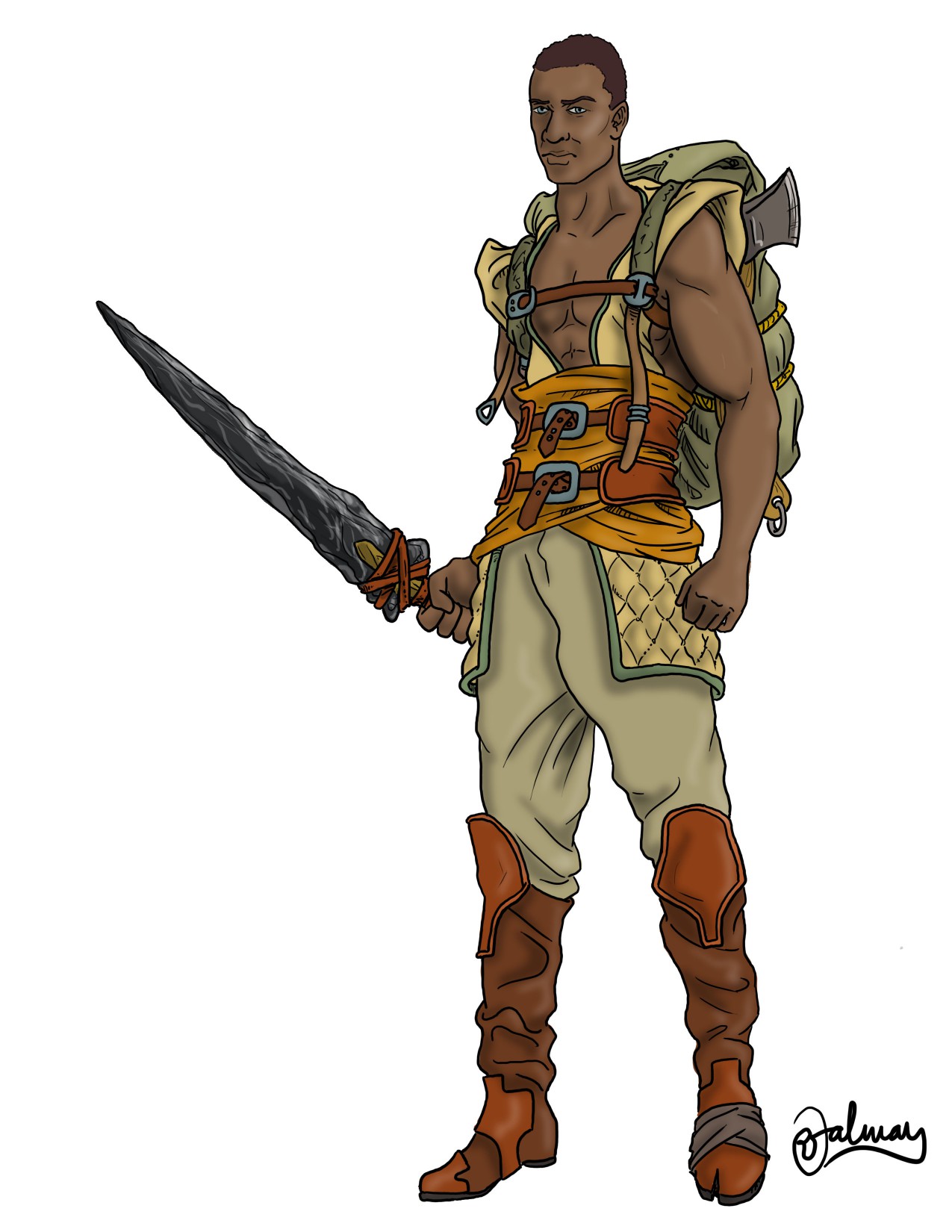
Seth Art by Ryan Salway Seth
Art by Ryan Salway


Soul and Song – Chapter 8

Tarun stood with crossed arms next to the wagon at the edge of the clearing, trying to keep his temper under control as the rest of Aluanna’s group gradually made their way in to the campsite. When the sorceress and her three satyrs had introduced themselves, Tarun had thought that just the four of them had driven off the attack of the phantoms. He soon realized though that they were just the first of a much larger band that followed soon behind.

The fire in the middle of the campsite was now well-fed and burning noisily, but despite the bright flames Tarun had a hard time counting exactly how many individuals made up the gathering in front of him. He estimated that there was a little more than twenty members of the group, but so many of them were either dancing, playing musical instruments, or otherwise actively moving about, that he couldn’t quite keep them all straight. Part of Tarun was glad to see the cheerful transformation that had come over the clearing in such a short amount of time. Another part of him was indignant that anyone could try to celebrate so jovially when something so foul was still lurking somewhere in the dark.

Tarun’s arm stung and his head pounded as he thought about the grinning face of Laronius. The pale villain had said he was a servant of Vdekshi, and that his master had invited Tarun and Shon to his stronghold because he was “very interested in meeting the former companions of Krall.” At the mention of Krall’s name, Laronius’ grin had widened menacingly, and a suppressed rage had exploded in Tarun’s chest. Tarun had tried to attack Laronius, but the effort proved to be as futile for Tarun as it was entertaining for Laronius.

Over and over, Tarun’s mind replayed the look on Laronius’ face when he said Krall’s name, and the memory made bile rise in his throat. How dare he even think to use Krall’s name! Tarun considered that Laronius must be as unlike Krall as any being could be. While the orc’s skin had been rough with scars and calluses, Laronius was pale and unblemished. Krall’s voice had been deep and gravely, but his words were direct, instructive, and encouraging. Laronius had a voice that was smooth and polished, but with a tone of mockery and words that contradicted his expression. Perhaps most importantly, Krall had hated serving a master like Vdekshi, while Laronius seemed to revel in it.

Lost in his thoughts of rage and disgust, Tarun was somewhat taken aback when the satyr with brown hair walked up to him, lightly strumming some stringed instrument. “Why the sour expression?” Toj asked in a voice loud enough that the whole gathering heard him. “You survived an encounter with Laronius and a whole swarm of phantoms tonight. You have every reason to celebrate with us. Isn’t that right?” A cheer went up from the band as Toj strummed loudly on his instrument.

“I’ll feel much more like celebrating once Laronius is dead,” said Tarun, and the gathering became much quieter.

“Well then you’re in luck, my dark-skinned friend,” replied Toj, still strumming away. “Because that pale devil was dead before you even met him tonight!” There was a burst of laughter, making Tarun feel somewhat self-conscious.

“Already dead?” asked Shon, as he made his way through the crowd to stand next to Tarun. “Are you saying that Laronius is some kind of zombie or something? Because he was pretty eloquent for a reanimated corpse.”

“Oh he’s no corpse,” said Roj, taking a break from playing his flute, “but he’s certainly not alive. That necromancer drained all the life out of him and replaced it with dark magic. He’s a vampire.”

Shon shivered. “My old teacher used to tell us stories from her people’s folklore about vampires who once roamed the tundra near her village,” said Shon. “She would tell us all the horrible powers that the vampires had, but she would always end the stories by telling us that it was just something that grandmothers in her country would tell children to scare them when they were naughty. But she forgot that I could hear her thoughts when she was telling the stories, and I knew she was actually scared.”

“Well I don’t know anything about the vampires where you teacher comes from,” said Toj, “but if they’re anything like Laronius, then she was right to be scared.”

“You seem to know a lot about him,” said Tarun.

“Yeah well let’s just say we’ve had more close calls with Laronius than we’d like,” replied Roj with a snort. “That’s what happens when you patrol the forest every night like we do.”

“Wait, you mean you people party like this every night?” Shon asked. “I thought we had just gotten lucky that you all just happened to be celebrating something when we got attacked tonight.”

“Luck had nothing to do with it, wizard,” said a melodic voice. Everyone quieted down as Aluanna moved from the center of the revelries to join the conversation. “This is my father’s forest and it is under my protection.”

“Your father’s forest?” Tarun replied. “Is he some kind of landlord or regional noble?”

“Nothing so mundane,” Aluanna responded. “My father is Lord of the Wood, Master of the Wild, and King of the Forest.”

“I don’t understand,” said Tarun. “I thought there were no more kings in this land. How can there be a king of the forest?”

“Then sit down, traveler,” Aluanna commanded. “Uncross your arms and open your ears, and I will share with you my story.”

As if on cue, all the members of Aluanna’s band sat on the ground, directing their full attention to the sorceress. Tarun and Shon also sat down, and as he sat, Tarun caught a glimpse of Seth for the first time since he had finally woken up. Seth’s eyes were wide and seem to be transfixed on Aluanna. One of the members of the band handed the sorceress a violin and bow.

“Aren’t you going to accompany her?” Shon whispered to Toj, Roj, and Soj, who were all seated nearby.

“Most of the time, yes,” Toj whispered back. “But the Song of Aluanna is best performed as a solo. I think you’ll see why.”

Aluanna brought the bow to the strings of her violin and the instrument let forth a long, clear note. She pulled the bow back and forth across the strings, creating a melody that everyone in attendance seemed to hold their breath to hear. As her bow danced across the instrument, her body began to sway with the rhythm, and it appeared that the whole forest was swaying with her.

Tarun looked around and noticed that the flames of the campfire seemed to be waving in place as if made of brightly colored ribbons. The stars appeared larger than usual and spiraled gracefully overhead. Everything in the clearing appeared soft and slightly out of focus, with the exception of Aluanna who appeared before them all in crystal clarity and brilliance. Tarun was vaguely aware that she was weaving some spell or enchantment on them, but he sensed no danger.

After finishing her prelude and setting the desired atmosphere, she opened her mouth, and began to sing.

Once an elf lord went a wand’ring

To and fro among his realm

Searching for some secret solace

‘Mong the birch and yew and elm

In his grief, his senses faltered

And his eyes saw things unseen

What a tragic lonely figure

Was a king without his queen

As the elf lord wandered hither

Through his forest kingdom wide

A young wood nymph saw his weeping

And with tenderness, she spied

She knew not from whence his grief came

But she promised to herself

She’d forsake all other ventures

And tend to the broken elf

Sev’ral years the nymph did follow

Out of sight and out of mind

Never fully comprehending

What the elf lord sought to find

Then one night came forth the answer

Crying out while he yet slept

For the wife who he’d seen perish

Bitterly the elf lord wept

Then the magic in the wood nymph

Glowing like a sunshine gleam

Sent her instantly inside him

And she entered in his dream

For her shape was ever changing

As do all wood nymphs in life

And the magic then transformed her

To the image of his wife

When the elvish lord awoken

He beheld with tear-soaked eyes

That his dear wife stood before him

As the wood nymph in disguise

He cared not how it could happen

For his grief had turned to joy

And within a year the couple

Had conceived a baby boy

This was all the king had wanted

With his queen and now a son

The boy’s eyes were green like clover

And he loved to dance and run

But the elvish prince was wild

Not befitting elvish lords

For just like his lovely mother

The young prince possessed no words

As the elf lord tried to tame him

The boy chose instead to flee

And once out of doors discovered

A new home of fern and tree

He was never truly elvish

Neither truly nymph indeed

But from each he gained some magic

That grew in him like a seed

Through the years that seed of magic

Grew inside him rich and strong

And he blazed his own fate forward

Deep in verdant nature’s song

Though his mother came from seedling

He was still the elf lord’s child

So proclaimed himself a new king

And the master of the wild

At the conclusion of the verse, there was a shift in the melody, and the melancholy undertones were replaced with a brighter tone and slightly quicker tempo. Aluanna smiled and inhaled deeply, then continued.

Oh the years moved ever onward

And he grew from boy to man

Yet he still was ruled by instinct

Without guile or thought to plan

And he gave no mind to courtship

That is ’til one fateful day

When a most peculiar maiden

Came dancing on her way

The Lord of the Wood did marvel

At the maid with deep red hair

For she ventured to his forest

Without trembling dread or care

While most mortals learned to fear him

And they made no forest path

For offending the great wood lord

Would most surely earn his wrath

And yet carefree was the maiden

As she danced throughout the glade

And the wood lord’s ire for trespass

Straightaway began to fade

She came not to plunder timber

Nor to kill for sport or food

She came only to make merry

And improve the forest’s mood

Then the wood lord did approach her

Knowing not how she’d respond

But the moment she saw his eyes

There was instantly a bond

For she’d fled her cruel village

Who had thought her mind was weak

For just like the mighty wood lord

She possessed no power to speak

Now in love the maid and wood lord

Danced together through his realm

And they made their home together

‘Mong the birch and yew and elm

And they married under starlight

Sharing vows most silently

The wood lord himself performed it

With his own authority

One year hence the maid and wood lord

Had conceived a daughter fair

With her father’s seed of magic

And her mother’s deep red hair

But the child surprised her mother

And her father the wood king

As she grew into a lady

That young woman loved to sing

She sang for the wild forest

Ever changing without end

And she found her songs had power

Full of magic to defend

So she left her loving parents

Though she’d always be their child

She knew she must go find others

Who’d help her protect the wild

And so now you know my story

From the tale that I have spun

As defender of the woodland

And the voice for those with none

My companions I have gathered

We traverse my father’s realm

Wand’ring as did once my elf sire

‘Mong the birch and yew and elm

When Aluanna finished her song, she stood straight and tall in front of her audience, panting and holding her violin and bow while the world around them retuned to normal. Some in the party looked forlorn or thoughtful, while others looked excited and were nodding to each other enthusiastically. Tarun looked over and noticed tears streaming down Seth’s face.

“My brothers and I have been traveling with Lady Aluanna longer than anybody,” said Toj, “and I still never get used to hearing that.”

“Is all of that true?” Shon quietly asked the satyr. “Even if nymphs were still around, I didn’t think it was possible for them to mate with elves or other mortal races.”

“Wizard, I will tell you this only once,” declared Aluanna. “My tale is true and I sing no lies. If you do not wish to believe it, then we have no business with one another.”

“It was beautiful,” said Seth with wide eyes as he walked over to them, holding his walking stick. “Absolutely amazing.”

“And what about you, my dark brooding warrior?” said Aluanna, turning to Tarun. “Are you so longing for battle that you were unmoved by my song?”

“Forgive me lady,” Tarun said as he stood up and crossed his arms again, “the strength of your magic is unquestionable, but there is one thing I still don’t understand. If this is your father’s realm, then why don’t you get rid of the foul creatures like Laronius and those phantoms once and for all? Why allow them to continue existing in this forest?”

Aluanna’s eyebrows furrowed as she regarded Tarun. “If only it were so simple,” she said. “But they are servants of Vdekshi, and his power is as inexplicable as it is unnatural.”

“Why?” demanded Tarun. “You and Shon use magic. Shon’s parents and uncle all possessed magical abilities as well. Why is Vdekshi so different?”

“The magic my father passed on to me is powerful,” said Aluanna, “but the power and potency of Vdekshi’s magic is uncanny. It belongs to another age of the world.”

“Or perhaps the magic comes from someone that belongs to another age of the world,” said Seth, excitement growing on his face.

“What are you talking about?” asked Aluanna, addressing Seth for the first time.

“Uh, well,” Seth stammered, a slight tremble creeping into his voice “what I mean is, you and Shon both channel magical energies yourselves, right? But as mortals, even amazing mortals, you have limits. But what if Vdekshi isn’t channeling that magic himself, he’s just… directing the magic of some more powerful being?”

“I think those phantoms scrambled you more than we thought,” said Roj, hitting Seth with his flute. “Because you’re talking nonsense.” The other satyrs laughed.

“I happen to have some experience in the matter,” grumbled Seth, looking embarrassed.

“You mean like that light from you lantern that struck Laronius in the face?” Tarun asked, ignoring the satyrs’ continued snickering. “Or that word you said that drove back the phantoms at first? What was that word again? Sharoo?”

“Shurrah,” replied Seth. As he said the word, a tingle went up Tarun’s back.

Aluanna held up a hand to silence the satyrs, and looked directly at Seth. “Say that word again,” she commanded.

“Shurrah,” said Seth, the tremble in his voice now gone.

Aluanna turned back to the satyrs. “Roj, play me the horizon right after the sun sets.” Straightaway, the stocky, black-haired satyr began to play a slow and lingering tune from his flute. “Soj, give me a lightly falling rain.” The tall, white-haired satyr began tapping with his drumsticks to make a faint and slightly irregular rhythm. The sorceress held her hand in the air for a moment as if trying to catch an idea from the wind. “And Toj, I need the frog pond at the end of summer.” The brown-haired satyr responded with a low set of repeating chords that seemed to tie the flute and percussion together at once.

Aluanna closed her eyes and swayed to the rhythm while Toj repeated his set of chords a couple of times, and then began to sing a slow, haunting melody.

When the misty night wind starts to howl

Shurrah, shurrah, shurrah

Faces in the darkness sniff and growl

Shurrah, shurrah, shurrah

Call back to the evil and the foul

Shurrah, shurrah, shurrah, my child

Shurrah, shurrah, shurrah

Aluanna held up a hand and the satyrs abruptly stopped their playing. “That’s a good start,” said the sorceress. “We’ll have to finish that up another time.” She then turned to face Seth again. “That’s quite the potent word of power,” she said. “What does it mean? How did you learn it?”

“As you probably already guessed,” replied Seth, “it translates roughly to ‘be gone’ or ‘depart’ as a means to ward off creatures of darkness.” Seth then looked down and gripped the handle of his walking stick with both hands. “As for how I leaned it,” he stammered, “I doubt you would believe me if I told you.”

“And do you always give in so easily to your doubts?” asked Aluanna sharply. “There are many who do not believe my story, yet I shared it with you and your companions tonight. It is your turn to do the same.”

“You’re right,” Seth said, lifting his head and planting his walking stick firmly on the ground. “It’s time I told all of you what I’m really doing here.”

Tarun Arty By Ryan Salway Tarun
Arty By Ryan Salway


Soul and Song – Chapter 7

The darkness in Shon’s mind seemed to be pulling him in a thousand directions at once. In Shon’s confusion and panic, he could vaguely recall that he had blacked out shortly after he and Tarun had refused an invitation from someone. Who was it? The details of the encounter hardly seemed important to Shon at the moment. All that seemed to matter was his current terror.

In the back of Shon’s memory, he recalled something his old teacher Empress had once told him about the tundra wolves that roamed her homeland. She had said that in the winter when the wolves became desperate for food, they would become particularly ferocious, attacking almost anything they came across. She told how she had once come across the scene of a pack of tundra wolves that had taken down a deer and the way they had each jealously attacked the dead animal, trying to secure a piece for themselves.

At the time, Empress had shared her experience with her students as part of some lesson about the effects of bullying, or cruel words, or something. The lesson didn’t seem important to Shon at the moment. What was important was that Shon’s mind now felt like the deer, a dead animal on a cold and frozen plane, being torn to pieces by hundreds of hungry and vicious creatures, but unable to react in the slightest or even call out for help.

As the creatures tore at one particularly tender corner of Shon’s mind, there suddenly erupted a roar of fury that shocked Shon. He supposed that it must have surprised the dark creatures as well, because immediately afterwards the biting and rending ceased for a moment and Shon was left to the cold, the darkness, his own pain, and silence.

Except that with the momentary pause in panic, Shon realized that all was not as silent as he thought. Far off in the dark distance, Shon could hear the impossibly low and malicious laughter of a nightmare he thought he’d forgotten.

“I warned you to run home, little larva,” the cruel voice said through the darkness. The voice did not seem terribly loud, but Shon marveled at how clearly he could hear it when he sensed that it came from so far away. “My enemies are not to be trifled with, and I have been preparing this one for quite some time. Leave your friend and cease meddling in affairs you don’t understand. Give in or give up this night. If you don’t, I promise you that your fate will be far worse than the one you face now.”

“Who are you?” asked Shon. As soon as he asked the question, he felt foolish and small, like he was talking to a great mountain hundreds of miles in the distance. Shon doubted whether he’d been heard at all.

Then came an answer, booming like thunder. “I am the force that will reshape this world,” the voice boomed. “I am the one who will save this world from death by atrophy and the decay of magic. I am the mightiest of the mighty. I am the bringer of strife and strength and a thousand years of war! No war can last without worthy enemies, and I have planned long and worked hard for mine.”

Shon wished that he could find some hidden corner to crawl into and escape that terrible voice, but he was completely naked and exposed to the empty void surrounding his mind. More than just the words and the tone of the voice, Shon could feel the contempt and anger that it felt for him.

At that moment, a thought came clearly to the front of Shon’s consciousness, momentarily pushing past all the other distractions in crystal clear focus. Why would such a being have cause to feel angry at him? The malice and mockery were somehow easy for him to accept, but anger? Shon thought of Empress’ lessons on anger and the weakness it showed. If this being was truly angry with him, then perhaps Shon was not as insignificant as the voice was trying to convince him he was.

For an instant, this thought gave Shon courage, and he considered more forcefully demanding to know who this terrible force was. But the being’s presence was still enormous and intimidating, and Shon decided to keep his small, secret piece of bravery to himself.

The fearsome consciousness finally began to withdraw, like the rolling away of great storm clouds, and Shon would have felt relieved, if not for his fear of the cold, dark wolves returning to attack his mind. But to Shon’s surprise, what he experienced next was not violence, but music.

A collection of notes, that at first seemed separate and disconnected, began to weave themselves together like a great woolen blanket. The blanket of music fluttered in front of him for a moment, as if on a breeze, and then wrapped gently but tightly around him, covering his naked consciousness and warming his soul. Light began returning to Shon’s mind along with images of fields and flowers and grass.

The scent of grass was evoked with particular strength. He could smell the freshly-grazed grass so powerfully that for a moment he imagined that he was back among the fields of sheep surrounding Alderfold. Just as Shon began to relax in the peacefulness of the vision, one of the rams in the field walked right up to Shon with his hairy face and began breathing hard on his face.

At that moment, Shon opened his eyes and found a rather grumpy-looking satyr standing over his body and staring at him with their noses nearly touching. “Alright,” the satyr said with a grouchy stare, “which one of you yahoos was butchering my flute?”

“Gah!” yelped Shon as he pushed himself up and scurried away from the furry-faced stranger. The satyr was stocky and appeared to be a considerably shorter than Shon. His legs were covered in black goat fur and he had hooves instead of feet. His torso and chest were bare and shaggy, and on top of his head were two twisting goat horns emerging from a long pile of hair the same color as his legs.

Shon looked around the campsite and realized that it was still nighttime, but the campfire was roaring and the stars were once again shining above. Shon found it odd that despite the night air, his surroundings somehow seemed brighter and more inviting than usual, as if the sunny ambiance of his dream had carried over into the real world.

Next to the campfire, Shon saw Tarun beginning to sit up with the help of another satyr. This second satyr had light brown hair on his legs and head and seemed a bit taller than the first one. He also seemed less grumpy than the one that was still staring at him, but Shon decided to keep that observation to himself.

A couple of steps away from Tarun, Shon saw a third satyr that was by far the tallest of the three. He had yellowish white hair on his legs and head, and although he was bent over at the moment, Shon could tell that he was probably even taller than Tarun. Because the third satyr was relatively thin, Shon thought his height gave him something of a stretched out appearance, but he also seemed to be the calmest of all three satyrs. A moment after Shon looked over at him, he noticed the tall satyr was propping up Seth against a nearby tree and trying to gently wake him up.

“I think I found your missing flute, Roj,” the tall satyr called over to the black-haired one that was still glaring at Shon. “I think this fellow over here was the one playing it.”

“Bah!” said Roj. “You can’t call that uncontrolled bleating ‘playing,’ Soj. If some idiot was using your drumsticks to bang on a tree, would you call that playing music?”

“Of course,” Soj replied with a peaceful smile. “You know that trees and rocks are some of my favorite surfaces to play on.”

“All right, bad example!” snapped Roj. “Just toss me my flute, will ya?”

“Easier said that done, mate,” said Soj. “This guy may look like he’s conked out, but he’s still got a wicked grip on the flute.” Shon saw Soj give a tug on the wooden flute in Seth’s hand, as if to prove his point.

“You’re being to blasted gentle, you big softie!” shouted Roj. “You’d think your legs were covered with cotton instead of wool. Let me come over there and I’ll get my flute, even if his arm is still attached to it.”

“Settle down, Roj,” said the satyr between them. “The flute’s not going anywhere, and I doubt that poor fellow is going to try to run off with it once he comes to. Let him wake up when he’s ready, and until then let him be. Seems like these gentlemen have been through enough tonight.” As the brown-haired satyr spoke, it struck Shon that if Soj seemed to be stretched out and Roj seemed to be a bit squashed, this other satyr seemed to be the ideal balance between them. The satyr had a handsome face and seemed to carry a mantle of confidence.

Shon felt a swell of relief as he saw Tarun begin to sit up and shake his head. “Excuse me,” said Tarun as he struggled to stand on his feet, “but who are you? What happened to us?” Tarun managed to stand for a moment before his knees gave way and he fell back to the ground.

“Whoa, take it easy big fellow,” said the middle satyr. “My name is Toj. These are my brothers, Roj and Soj. We don’t mean you any harm. As for what happened to you, we were really hoping you could tell us. How did you manage to stumble into such a bad nest of phantoms? You’re lucky to even be alive.”

“We didn’t stumble into them,” said Tarun, holding his head as if trying to shake water from his brain. “We were attacked. They were with a man named Laronius. He said he just wanted to give us an invitation, but when we refused, the situation became… unfriendly.”

“Amazing,” said Toj, turning to look at Shon. “You know, your friend here may be the most gifted underestimator I’ve ever met. And if what he says is true, your survival is a lot more than lucky. It’s downright miraculous.”

“What do you mean?” asked Shon, surprised at the shakiness in his own voice.

“Well, let’s just say that we’ve encountered that devil Laronius before,” said Toj. “He’s not to be underestimated, and certainly not to be trusted. It’s not every night we meet someone who’s met Laronius and still been breathing afterward. Still, that was one nasty swarm of phantoms, even for Laronius. I don’t think we’ve ever driven off a swarm quite that large before tonight.”

“You mean you’re the ones who drove off all those phantoms?” asked Shon.

“Well, in all honesty, no,” replied Toj. “We helped provide some of the accompaniment for the spell that cleared away the darkness, but we can’t actually take credit for it.”

“Well then, who did?” Shon asked.

“That would be me,” said a clear and melodic voice. At that moment a beautiful red-haired young woman stepped into the firelight. Her black and green dress was simple, and she wore no shoes, but she walked with a stature and grace that seemed to befit royalty. As soon as she entered the clearing, the three satyrs all bowed their heads in respect and reverence.

“May I present,” announced Toj, raising his head again, “the Voice of the Land, and Heir of the Wood. The Lady Aluanna.”

In that instant, Seth jerked awake, shaking his head in confusion. In a daze, he raised the flute to his lips as if to blow into it again, but stopped when he saw the Lady Aluanna standing in front of him. Seth’s eyebrows raised and his jaw drooped a little bit as he dropped the flute in his hand. “Oh wow,” he muttered, and then collapsed face first back to the ground.

Illustration of Shon by Ryan Salway Illustration of Shon
by Ryan Salway


Soul and Song – Chapter 6

As Seth walked quickly through the forest, he saw that the narrow beam of light in front of him coming from his lantern began to gradually intensify and widen until there was a small and hazy circle of light all around him. Seth didn’t know what had caused the light to change, but he was grateful for it. Something in the gloom of the woods that night was unlike the usual dark of nighttime. Perhaps it was because of the increasing autumn chill and the lack of familiar sounds from frogs, crickets, and other night animals, but the deafening silence felt eerie and unnatural.

Seth began stepping a bit heavier than usual, hoping that the sounds of the sticks and leaves crunching under his feet would comfort him. To his dismay, there was something wrong about the sounds that only made his unease increase. At first he thought that his ears were plugged or the sounds were muffled, but he realized that what he found so distressing was the lack of the slightest echo. It was as if the sounds traveled only as far as his own ears and then abruptly stopped.

Strange shadows flickered just outside of Seth’s vision, shifting like the shadows of smoke against the edge of his small circle of light. It was as if the darkness itself was trying to creep in from every side. Seth could not be sure if it was merely his own imagination and fatigue playing tricks on him, or if there was something more sinister going on, but either way it left him wanting to get back to camp as quickly as possible. For a moment, Seth was seized by the sudden urge to give in to panic and run aimlessly into the night.

Seth took a steadying breath and continued to step forward at a deliberate pace. He tried to remember the strength and peace he had felt that night on the beach when he was given the lantern. As if in response, the lantern in Seth’s hand grew warm, and the warmth seemed to flow up Seth’s arm and into his chest, filling him with courage. Seth stopped walking and looked around him. He noticed that although the light around him was dim, it was no smaller than it had been before the feeling of dread began. Seth smiled with confidence. Whatever may be lurking in these woods was no match for the light in the lantern.

But along with the warmth and courage that flowed up his arm, so too did a renewed sense of urgency to return to the camp with his firewood. For the first time, it occurred to Seth that the feeling of urgency was not for his own welfare, but for those he was rushing to. Seth was now certain that there was something unnatural hiding in the dark of the forest, and while he may have the magic of the lantern to keep him safe, Tarun and Shon did not.

This time Seth did give in to the urge to run, but now it was with purpose, not panic. Whatever was happening this night had something to do with the reason Seth had been led to this land and this forest. After so many weeks of following the lantern with no clear understanding of his end goal, Seth felt a thrill of excitement at the prospect of being useful and doing some good. He was eager to make his master proud, and tonight he might finally have his chance.

As Seth ran through the woods in the direction of Tarun and Shon’s camp, he began to lose himself in the moment and he nearly forgot about his earlier fear in the darkness. The light from the lantern grew brighter for a while, but Seth was so focused on the direction he was heading that he didn’t even notice when the beam of light narrowed and shifted to his right.

Seth became aware of his mistake as he felt his footsteps become heavy and his movements and thoughts both slowed as if moving through tar. Even blinking seemed slow and heavy on his face. His head swam as he turned his head to see the thin beam of light shining dimly and distantly to his far right. Seth tried to correct his course, but he felt as if cold tendrils of darkness were trying to hold him in place and prevent him from turning in the direction of the light. The darkness seemed to tighten around his chest, making his heart pound uncontrollably and his breath was short.

Seth continued to fight against the darkness and try to turn, but he felt as if he was losing the fight. Ultimately, it was his shillelagh that made the difference. Seth hardly ever used it as a walking stick, but in his desperation he tried to do anything to fight against the pull of the dark threads binding him in place. As Seth placed the shillelagh firmly on the ground next to him and tightly gripped the handle, he finally began to make progress against the darkness. He could still feel the weight of the tugging, but it no longer held him in place.

Gradually, step by step, Seth made his way to the spot where the beam of light focused. Seth was relieved when he returned to the safety of the circle of light, but his elation had passed. His own enthusiasm had gotten the better of him, and he had become careless. He promised himself he wouldn’t make that mistake again.

Seth studied his surroundings and tried to determine where his guide intended to take him now. But to Seth’s confusion, the light from his lantern had stopped moving. Seth found that he was safe within the circle of light, but in front of him there was nothing but a thick darkness that he could not see past. Seth was certain that his new friends’ camp was on the other side of the darkness, but it seemed an impassable barrier. Though heavy, the darkness seemed to move and writhe in front of him like a slow moving smoke or a bucket of ink that had been dropped into a pond.

Seth looked around trying to weigh his options, but the sense of urgency that he felt before began to return. He knew he wouldn’t have time to find another way past before something terrible befell Tarun and Shon. Unsure of what to do, Seth looked at his lantern, but the object just continued to illuminate the same spot where he stood. Finally, steeling himself, Seth decided he had no other choice and walked directly into the darkness.

Immediately Seth felt the sensation of thousands of web like strands of darkness try to grasp at his arms and legs. Instinctively, Seth reared back and swung his shillelagh at the dark tendrils. At that moment, a word came to Seth’s mind, just like earlier in the day when he had unexpectedly known the right word for healing Tarun’s arm.

“Shurrah,” Seth whispered. The darkness in front of him shuddered.

Seth stepped forward and swung his shillelagh at the darkness. “Shurrah,” Seth said again, more forcefully this time. Seth did not know how he knew the word. It belonged to a language that was not his. It was an old and forgotten language not spoken for thousands of years, but he had been promised he would learn it. Though the word on his lips was unfamiliar to him, Seth somehow knew that its meaning was roughly translated to “depart” or “be gone.”

Every time Seth repeated the word and swung his shillelagh, the darkness would tremble and retreat a few paces before him and the light from his lantern would fill the space. Courage began to well up inside Seth, and he could tell that he was nearly through the wall of darkness. With one last shout of “Shurrah!” he burst through the other side.

When Seth stepped through into the dim firelight on the other side, he realized that the worst was yet to come. A strange thick mist hovered a few inches above the ground, giving off an eerie blue light in the campsite. The campfire in the middle of the clearing was a good size and the logs in the fire crackled and popped as they burned, but the light from the fire seemed unable to illuminate more than a small circle a couple of feet in diameter.

Just outside of the circle of firelight, Seth could see Tarun kneeling on the forest floor among the strange blue mist. His large, dark-skinned arms were shaking violently, and his hands seemed to be grasping at something unseen. After a moment, Seth could see that Tarun had been trying to lift Shon, who had been completely covered by the mist. The wizards pale skin looked lifeless and blue to Seth, though he couldn’t tell if that was merely an effect of the strange blue luminescence.

At the other end of the clearing, Seth heard a voice that was cruel and mocking. “Really now,” said the voice with feigned concern, “my master is a most gracious host, but I’m afraid that he’s made it clear that refusing his invitation is simply not an option.” Seth’s eyes followed the direction of the voice and saw a thin, pale figure hovering slightly above the blue mist.

“Of course, you could refuse again,” said the pale stranger, smiling widely. “But then, I would have to try to persuade you again, and I think your little friend there has already had his fill of my kind of persuasion.” Tarun said nothing, but Seth saw him try to pull himself and Shon closer to the warmth of the fire.

The pale stranger’s smile widened with wicked satisfaction. “I’m afraid that a lack of acceptance will also be considered a refusal,” the stranger said. “And now it looks like you’re trying to escape, which I was told to prevent by any means necessary.” The figure extended a thin, outstretched hand towards the pair, and began to float quietly towards them.

“Stop!” shouted Seth, as he ran to intercept the stranger’s path. Wherever Seth stepped, the blue mist evaporated around him. “What are you doing to them?”

The stranger stopped and his smile faltered as he looked at Seth, clearly surprised by his interruption. He glared at the opening where Seth had emerged into the clearing, as if angry at the darkness for failing to keep him out. The stranger cocked his head to the side and forced his smile to return, though it was thinner now and not nearly as wide.

“I was merely delivering an invitation to them,” the stranger said. “A private invitation,” he added with deliberate contempt in the emphasis. “In fact, this entire conversation was meant to be private. This does not concern you, and I suggest you leave while I’m giving you the chance.”

“I’m traveling with these men,” Seth responded. “So whatever you’re doing to them here does concern me.”

“Traveling with them?” asked the stranger. “I’ve been keeping tabs on these two for some time now, young man. You certainly weren’t traveling with them last night.”

“I met them earlier today,” Seth said, “but I’m pretty quick with my loyalties. I’m not leaving them to you.”

“I’m not sure how you managed to get past my phantoms,” said the stranger, twisting the smile on his face, “but I can assure you that one word from me, and they’ll descend on this clearing like a flood and tear your soul apart. You have no idea with whom you are dealing or the power I possess.”

“Neither do you,” said Seth, stepping towards the stranger. Seth raised his lantern and swung his shillelagh in a wide arc. “Shurrah!” he shouted. Immediately the blue mist in the clearing dissipated and left only the orange glow of the firelight. In the flickering light, Seth could see an expression of rage and hatred come across the stranger’s face, made only more terrible by the shadows dancing across his sharp features.

“You want to know who I am?” Seth asked. “I am Seth the Fourth, son of Seth the Liar, son of Seth the Thief, son of Seth the Traitor. I am a servant of…”

“Did you say Seth the Traitor?” the stranger interrupted, a smile starting to return to his lips.

“What?” said Seth. His heart was pounding in his chest, and he felt the warmth from the lantern, as if it was urging him to stay on his course. Just one more “shurrah” and your friends will be safe, his mind seemed to say. And yet Seth couldn’t resist his curiosity. “What did you say to me?” he asked.

“Are you really the great-grandson of Seth the Traitor?” the stranger asked, excitement rising in his throat. “Of course, I knew those markings on that little stick of yours looked familiar.”

It was more than Seth could bear. His own father had always refused to tell Seth anything about his own family other than their names. And now it seemed that this foul creature knew more than he did. Somewhere in the back of his mind the word “shurrah” continued to echo over and over, but Seth ignored it. “What do you know about him?” Seth demanded.

“Oh, I don’t know much,” the stranger said coyly. “It’s my master who could tell you stories. Perhaps I was too hasty to exclude you from his invitation. Come with me and your friends to my master’s stronghold, and I’m sure he’ll answer any questions you have about Dear Old Granddad.”

Seth was so wrapped up in the conversation that he did not even notice the thick tendrils of darkness snaking up his legs, or the return of the blue mist. Too late, Seth looked down and recognized the trap. He tried to swing his shillelagh and shout, but the dark tendrils wrapped around his throat, choking him.

“That was a nasty little trick you pulled a second ago,” spat the stranger. “I don’t know where you learned a word of power like that, but obviously once I get you back home I’ll need to be sure to cut out your tongue before you wake up.”

Seth struggled to breathe and looked at the lantern in his hand. Immediately, there shot out a beam of light brighter than the sun on a clear day. The narrow shaft of light struck the stranger directly on his right eye. The stranger let out a bloodcurdling scream and the darkness released its grip on Seth’s throat.

Unfortunately, in his rage the stranger had lashed out and knocked the lantern from Seth’s hand. The rusty lantern sailed across the clearing and landed in a bush. Without the protection of the lantern, the darkness quickly began to advance on Seth again.

“How dare you?!” the stranger screamed, clutching his eye. “You’ve sealed your own fate. I won’t be holding back my phantoms from you or your foolish companions anymore. Enjoy having your sanity flayed and your souls gutted!” And with that, the stranger took flight and disappeared into the night sky.

Seth watched the oncoming darkness advance towards him. He wanted to run for his lantern, but he was already cut off. Tarun and Shon would die tonight and it would be all his fault. He felt like a fool for not using the power he had been given to cast out the stranger when he had the chance.

Seth looked at the campfire dying as it was being consumed by the thick darkness. He wondered if he might buy some time by feeding the fire with some of the wood he had collected, but he realized that in all the commotion and confusion of the night, he had dropped all but a single piece of the wood. Seth eyed the wood and realized it was the strange flute that the lantern had shone on earlier that night.

With the darkness closing in from all sides, and with no other options, Seth lifted the flute to his lips and blew hard. Out of the flute came a single long piercing note. The sound reverberated through the forest and the darkness halted.

Then, from somewhere among the trees, another long clear note answered back.

Seth Art by Ryan Salway Seth
Art by Ryan Salway