
Shon stood outside his uncle’s home, trying to prepare himself for the argument he was about to start. He could feel himself sweating from a combination of the heat outside as well as his nerves, and he was grateful that the ability to sweat had returned to him four days previous. He could remember clearly the day that the effects of the Camel Truffle had finally worn off. When he had gone outside to relieve himself that day he was shocked to observe that any person could urinate so much.
As he considered going in to talk to Grodin, his bladder felt weak once again. He had spoken to Grodin before of leaving the desert, and it had never gone well. For some reason it brought such frustration and resentment out of his uncle that the summer equinox had been two years since the last time he had brought it up. The last time Shon had asked to leave Life’s Edge, Grodin had ended the conversation by practically threatening to kick him out of the house.
None of that mattered now, however, because Shon had decided that he had to leave. When he, Tarun, and Grodin had returned from the Endless Desert, Tarun almost continued to walk right out of town that day. Shon had tried desperately to convince him not to leave, but in the end Shon succeeded only in convincing Tarun to stay another seven days to let the wounds on his arms and legs heal. During that time he had talked with Tarun, and the two of them had decided that he would leave with Tarun after he had the chance to talk with Grodin about it. The trouble was that Tarun’s wounds were healing much faster than Shon had expected, and now he was growing impatient.
Shon was determined to follow through with his plan. Tarun was the best friend Shon had ever had, and if he didn’t go with him, they would probably never see each other again. After all, Tarun was plenty strong, but with no memory whatsoever, other than what he had gained in Life’s Edge, Shon was uncertain how his friend would fare with no assistance. Leaving together would give both of them the best chance of surviving on their own.
Shon squared his shoulders and took a deep breath as he stepped up to the door, preparing to confront his uncle. He grasped the handle firmly, and pushed the door open, only to find the house empty and the shutters drawn. All at once Shon felt his courage falter and a feeling of profound foolishness for getting himself all worked up. He thought his uncle was in the house, but why hadn’t he used the magic of his mind to confirm it? I have to start thinking like a wizard, he told himself. Closing his eyes to block out distractions, Shon listened with his mind, and quickly discovered that Grodin was right next-door in the greenhouse.
Shon hurried outside, flustered that he would not have time to prepare himself again to face his uncle. He rang the brass bell a bit louder than he intended, and the feeling of foolishness once again assaulted him, making the tops of his earlobes burn. He did not have to wait long before Grodin came out the door of the greenhouse. “What is it, nephew?” he asked.
Shon had paid attention the last time he observed Tarun speak in his commanding tone, and tried to do his best to mimic his voice and body language. He squared his shoulders, placing both feet directly beneath each shoulder, put his hands to his side instead of fidgeting or grasping each other, and looked Grodin directly in the eye. “Uncle Grodin,” Shon said, “we need to talk right now.” Shon was greatly disheartened at how his voice faltered and cracked at the end of the sentence.
Grodin inspected Shon up and down for a long moment, then said, “Yes, I think we do. Come in to the greenhouse, Shon.”
Shon tried not to show his surprise at his uncle’s invitation. The last time he had been allowed inside his uncle’s greenhouse he had been much younger. He could not even remember what the inside looked like. Trying to remain focused on the issue at hand, he entered the door held open by his uncle.
Shon coughed several times from the unexpected humidity inside the greenhouse, and he began to remove his tunic, only to remember that he had not worn an undershirt that day, and so he left the tunic on out of embarrassment. Meanwhile, Grodin had walked to opposite side of the greenhouse and began trimming a strange thorny plant that Shon did not recognize. “So,” asked Grodin, “how soon will you two be leaving?”
This question left Shon completely speechless for several moments, and when he finally regained his voice, all he could manage was a weak, “What? Who?”
“You and Tarun leaving Life’s Edge,” said Grodin, pausing from his work with the thorny plant. “Isn’t that what you came to speak to me about?”
Shon was able to regain some of his composure this time. “Yes,” he replied shakily, “and nothing is going to change my mind about this!”
“Nothing, eh?” Grodin said, with a strange expression on his face. “Not even knowing that if you leave, you will never be able to come back and live in my home again?”
Shon’s resolve wavered for a moment, and he did not want to offend his uncle or lose the only home he could remember. Then, regaining his best commanding posture and tone, Shon responded, “No Uncle Grodin. I don’t know why this makes you so angry, but even if I will no longer be welcome in your home, I will not change my mind. I am leaving Life’s Edge.”
“Good,” Grodin said, wiping dirt from his hands to his pants. “It’s about time. Now take a seat, nephew. I hope you remember all of those questions you’ve been asking all these years because I can finally answer them.”
Shon found a stool close to him and dropped himself down on it. He could hardly process what was going on. His uncle was not upset at all. If anything he seemed relieved. Does my uncle really think so little of me? Shon wondered. Have I really been such a nuisance to him all these years? Shon felt that he suddenly didn’t know his uncle at all, and the thought crushed him.
“On second thought,” Grodin said, “why don’t you hold your questions until I finish. There is a lot you need to know, and it will help if I start from the beginning. I hope you can forgive me, Shon, but there were certain secrets I had to keep as long as you lived under my care.”
Shon’s heart suddenly lifted. His uncle wasn’t relieved that he was leaving. He was glad to finally reveal the truth. “What secrets?”
“Family secrets,” Grodin said. “Concerning your mother, your father, and myself.” Grodin pulled up a stool to sit next to Shon, and took a deep breath. “Where to begin?” he wondered out loud. “I suppose you would most like to hear about your parents. I couldn’t even tell you their names in case you ever came across someone who had heard of them.”
“Were they famous?” asked Shon.
“In certain circles, they were both quite well known,” Grodin replied with a smirk. “Your father’s name is Alla Nen, and your mother is Pedhma. I met your father when we were both quite young and foolish. I imagine we both would have died long before you were born if we hadn’t had each other to watch our backs. He was as loyal and clever a friend as I could have ever hoped for, and the most skilled mage I have ever encountered.”
“Your mother, as I have told you before, is my younger sister. It was I who introduced them, and I’m still not sure whether or not it was a mistake. Pedhma was several years younger than Alla Nen and me, and she had only recently begun to develop as a sorceress, but she was one of the fiercest souls I have ever known, and it didn’t take her long to catch up to us in skill.
Shon had tried to interject at this point, but Grodin raised his palm to silence him. “Interruptions at this point will only make things take much longer,” Grodin said before continuing.
“The three of us traveled together for a long time,” Grodin said with a smile, “and we each made a name for ourselves. Even those who didn’t know our names had heard of the Sorceress, the Mage, and the Druid.”
“A druid!” Shon said in wide-eyed astonishment. “No wonder you know so much about plants!”
“I know a great deal more than that!” laughed Grodin. “I am quite out of practice, but I imagine there is still little hope of any foe defeating me when I am surrounded by real forest. You know that I am not fond of braggarts, nephew, but I have never found another druid that could match me in knowledge or skill.”
“The same could be said of both your parents. Both were unparalleled in their particular skills. Your father excelled at constructing magical items and equipment with near flawlessness. He had particular skill in creating items that could respond to the thoughts of their owners. Your mother’s specialty was conjuring, and she was sought particularly to create familiars for other wizards and magic users. Her magic was tied closely with the emotions of others, and this enabled her to conjure according to the personalities of her patrons. I had never known such warm and faithful companionship than among the three of us.
“For your mother and father, however, companionship led to affection, and ultimately to love. It was on their wedding day that I decided that they should share their lives together without me. They did not object strongly, and they appreciated my approval of the marriage. I never realized how much I would miss them until the day we parted ways.”
Grodin was quiet for a moment, then looked up at Shon and shook his head saying, “Listen to me. I’m rambling on like an old man. You want to know what all of this has to do with you. Well, let me get to the point. You probably won’t remember much of what I’m going to tell you because you were still a very young boy when the two of us came to live in Life’s Edge.”
“The two of us?” Shon interrupted, “I thought you already lived here, and I just came to live with you?”
“No,” replied Grodin “we came here together. I had only visited Life’s Edge once before we came to live here. I was not very impressed with the place, but your parents insisted, and I had made a promise.”
“What promise?” Shon insisted, growing impatient. “Why have we been living in Life’s Edge if you didn’t even like it here in the first place?”
“Shon,” Grodin said, “when you were born, your parents adored you. They were both passionate people, and everything they did they threw their whole hearts into. You were no exception. It wasn’t long before they started planning and fantasizing about your future and what you would become. The trouble was that your parents both had very different plans. They both wanted you to follow in their footsteps.”
“They were both magic users though,” said Shon. “Why should that have been a problem?”
“Your father held very firm to the practice and philosophy of mages,” said Grodin. “He was amazing at finding new ways to use his magical abilities, but he always documented the process meticulously, so that he could recreate the process. As a sorceress, you mother had been trained that magic could only be potent when it was used by instinct; never the same way twice. Your father wanted to see you become a mage, your mother wanted you to become a sorcerer, and they could find no way to come to any agreement.
“As you grew, the arguments became more heated, and threats and accusations became harsh. When your parents contacted me for help, they could hardly speak to one another. They had hoped that I could act as a mediator between them, because I loved them both. I did my best, but emotions were too raw, and neither one would give any quarter. Neither one wanted to give up on the potential they saw in you.
“It was I who eventually came up with an idea that I hoped would be for your best interests in the long run. Since your parents could not think clearly at the time, it was agreed that you would live with me while the two of them took some time away from the issue and each other to let their tempers cool. When they finally felt that they could speak rationally with each other again, then they would return and I would turn you over to their care once again.
“Unfortunately, their long quarrel had left them scared and suspicious, even of me. They agreed to my plan only if I would make certain promises to them. I was not allowed to let you learn any magic until they both returned and came to a decision, or until you were no longer under my care. I was not allowed to tell you anything about your parents for fear that if you learned of them you might start to favor one over the other.
“The third condition was that we had to come to live here in Life’s Edge where I would be unable to use my magic as a druid, and thereby influence you to follow in my path of magical development. Life’s Edge also seemed ideal to your parents, because with the severe lack of magical energies, it was unlikely that you could develop your magical talents without them. I don’t think any of us expected for you to remain here this long.”
“What do you mean?” asked Shon. “Why didn’t they ever come back for me? Don’t they still want me?”
“I’m sure that they do,” replied Grodin in a firm, but gentle voice. “Which is why I cannot say why they have not returned. I have stayed awake countless nights wondering the same thing. They were both so formidable, that I find it hard to believe they are both dead, unless their arguments became so fierce that they attacked each other.
“Attacked each other?” Shon shouted, his voice breaking. “My family is broken, and my parents may have killed one another all because of me!” He could feel his throat constrict and tears began to burn behind his eyes.
“No!” shouted Grodin, slapping his thigh and looking intensely into Shon’s eyes. “Your family was broken because of your parents’ cursed stubbornness and pride! I love them both dearly, but I may never forgive them for what they let their arrogance do to you.” Grodin sat stiff on his stool, his fists clenched with white knuckles. “Forgive me,” he finally said. “I spoke unwisely. I have no evidence that your parents ever attacked one another, and I should not have burdened you with that thought. In my heart, I do believe they are both still alive.”
“However,” Grodin said, standing up and walking to a corner of the greenhouse, “they both led adventurous and dangerous lives, and so they gave me instructions in case neither returned. They told me that when you were finally old enough to leave my home and my care on your own that I should give you their gifts.”
“Gifts?” Shon asked, unable to contain his excitement at the prospect of receiving something from his parents.
“Yes,” said Grodin, “they agreed that they would each be allowed to leave you one gift in case something happened to them, and they could never return. They are gifts of no small value, though they may seem unremarkable at first. I’ve been hiding them here in my greenhouse ever since you became old enough to snoop around the house.”
Grodin turned to a large crate of soil that he was standing next to. After a moment, Shon realized that the crate was actually a box and that only the lid on top had any soil in it at all. After removing the lid, Grodin reached inside the box and retrieved a large bundle of red cloth and some sort of stone. After setting down the stone, he flapped the bundle of red cloth hard, sending bits of loose dirt and dust into the air. When Grodin held the cloth up unfurled Shon could see that it was an old and dirty hooded cloak.
“This is a traveling cloak that your father made,” said Grodin proudly. “It may not look like much, but it is protected from several forms of magic, and the material is so tough and durable that your father had to use enchanted shears just to cut the fabric. This cloak saved Alla Nen’s life several times.”
“My father wore this cloak himself?” Shon asked excitedly.
“Of course,” Grodin replied with a smile. “If you look on the right shoulder, you can see the insignia of Alla Nen. That insignia was always on his creations, and he enchanted the design so that it could never be copied or impersonated.”
Shon stepped toward his uncle and wiped the dirt away from the right shoulder to reveal a design of the moon on fire. “May I put it on?” Shon asked.
“You might want to consider washing it first,” said Grodin with a smile, “but if you don’t mind the dirt, I’m sure it won’t mind you.”
Shon quickly took the cloak from his uncle and put it over himself. It seemed a little large for him at first, but as he wore it, the cloak almost seemed to change to fit him better. As he turned around, Grodin smiled wide. “Well how about that?” Grodin said, “you really do look a lot like him.”
Shon was so excited at the prospect of looking like his father that he pulled the hood of the cloak over his head, despite the heat of the greenhouse. As soon as the hood covered his head, Shon let out a sudden gasp. “Uncle!” Shon shouted, “everything has gone silent! I can’t hear anything!”
“What?” Grodin asked, alarmed. “What do you mean?”
“Wait,” Shon said slowly, starting to calm down. “No, I can hear you. But something about your voice is different. I can only hear you when you’re talking.”
“You’re not making any sense, nephew,” Grodin said. “Take the hood off.”
As soon as Shon removed the hood, his eyes opened wide and his face lit up with understanding. “That’s it, uncle!” Shon said. “When I had the hood on, I couldn’t hear your thoughts anymore. I couldn’t hear anyone’s thoughts, not even a whisper!”
“Interesting,” Grodin said, stroking his beard. “Your father used to pull that hood over his face when he was trying to think or focus on a problem. ‘It quiets my thoughts,’ he used to say. I wonder…”
Shon experimented a few times with the hood, pulling it over his head and taking it off again. He discovered that he could still hear his uncle’s thoughts while wearing the hood, but only if the opening of the hood was directly toward him.
“That may prove a valuable tool in learning to focus your abilities, Shon,” Grodin had pointed out.
“What about that?” Shon asked excitedly, pointing to the stone that Grodin had set down earlier.
“Ah,” said Grodin, picking up the object. “This will take a bit more explaining. I told you before that your mother was particularly famous for creating familiars for other magic users. Do you know what a familiar is?”
“A magical animal that follows a wizard around?” Shon guessed.
Grodin smiled wide. “That is a fairly rudimentary description,” Grodin said, “but you have the right idea. A familiar is a creature conjured up by a wizard or other magic user to be a companion, a general helper, and sometimes even a protector. Many familiars appear to be regular animals like ravens, cats, or snakes, which exhibit exceptional faithfulness as pets. Others look quite more exotic or fanciful, or possess unique powers of their own. If conjured skillfully, a familiar will also act as a reflection of the wizard it belongs to. What your mother left you, is a familiar egg.”
Grodin handed Shon the object and he looked at it with confusion. It looked and felt more like a fist-sized rock than any sort of egg he had ever seen. Instead of being round, it was angular, jagged, and irregular in shape. It also felt quite solid. It was mostly white, but it also had a slight luster that shimmered with several different colors when held in the light. It was slightly warm to the touch, and as he held it he had the unsettling sensation that it had a pulse.
“What should I do with it?” Shon asked.
“Just keep it close to you,” answered Grodin. “It will gradually absorb any excess magical energies that you harness, as well as slowly imprint on your thoughts and personality. Eventually, when it has absorbed enough of your characteristics and magical energy, it will release that energy and conjure your own familiar. Your mother created the egg, but for all intents and purposes you will be the creator of the familiar because it will be conjured from your magical energy.”
“When will that happen?” Shon asked excitedly.
“It’s impossible for me to say,” said Grodin. “It will happen much sooner if you always keep it close though. Oh, and don’t worry about it breaking. As I’m sure you can already tell, it’s quite solid, and quite hard.”
Shon slipped the familiar egg into one of the several inner pockets of his new cloak. “Thank you, Uncle Grodin,” he said. “Thank you for these gifts, and especially for finally telling me about my parents. You don’t understand how much it means to me.”
“For once,” said Grodin with a smile, “I think you are right about what I don’t understand.” Grodin clapped his hands together. “Ah,” he said as he walked towards the door of the greenhouse, “before I forget. Now that you are no longer under my direct care, there is something else you should have for now.” Grodin picked up a rod of wood nearly as tall as he was that was leaning against the doorframe. “I asked your parents if I could give you a gift as well, but they refused,” he said. “So this will have to just be on loan until you can return it to me.”
“Thank you, Uncle Grodin,” said Shon, “I know you are quite fond of this walking stick.”
“Bah!” said Grodin, pulling the rod away. “You forget I am a druid. This is my staff, not some mere walking stick. This staff was grown for me by a very old and wise magical tree from one of her most sacred branches. There is deep magic inside it, and I will not see it disrespected.”
“Forgive me,” said Shon quickly, “I did not mean offense. Until today I always thought you were merely a gardener, and that was merely your unusually long walking stick.”
Grodin let out a chuckle and relaxed himself. “Yes, I suppose that is true,” Grodin said. “I can hardly blame you for your ignorance when I was the one keeping you in the dark all these years. I do want you to take this seriously though, Shon. Do you know why most magic users carry a staff or wand?”
“To channel magical energies through?” Shon ventured.
“That’s correct,” Grodin said, impressed. “Magic users are natural conduits of magical energy, but having a proper staff or wand helps to reach those energies more effectively. Think of it like a lightning rod in a storm. The energy will be more attracted to such a conduit, which supplies more of those energies to the magic user.
“Different staffs are better equipped to channel certain types of energy than others, so it often takes magic users several years before they find one that best serves their purposes. I don’t imagine that my staff will be nearly as effective for you as it is for me, but it will be better than nothing to start out with.”
“Is it true that most magic users give their staves or wands names?” Shon asked.
“It is,” Grodin said with narrow eyes.
“Will you tell me this staff’s name?” asked Shon.
“That’s a rather personal question,” Grodin said quickly. “Still,” he said after a pause, “I suppose I should tell you if you’re going to be using it. But I first want you to promise that you will not laugh at the name.”
“Of course I promise,” said Shon, confused.
“Hmm,” grumbled Grodin, “that isn’t a promise your mother or father were able to keep. Still, I better tell you so you don’t go trying to give it a name yourself. That would be a real mistake.” Grodin paused for a moment, and then said, “Its name is Stick.”
Shon managed to control himself enough to not laugh, but he could see why his parents had. “That seems a rather simple name,” he said with a straight face.
“Many with lesser staves have said the same,” said Grodin. “It was what its mother tree called it when she gave it to me, and I have found the name to be sufficient. Now, are you ready to receive it?”
“I believe so,” Shon replied.
“Good.” Grodin held the staff out towards his nephew. “Shon,” Grodin said in a loud voice, “I present to you my staff and give you temporary stewardship over it. Stick will treat you as its master until it is returned to me.” He then handed the staff over to Shon.
As soon as Shon’s hand made contact with Stick, he was astonished. His mind was suddenly opened further than it had ever reached before. It was as if wax plugs had been removed from his ears for the first time in his life, so great was the increase of clarity with which his mind heard the thoughts of others. He was amazed to find that he could now hear the thoughts of everyone in Life’s Edge, and he possessed far greater accuracy in finding and singling out the thoughts of individuals among the crowd. “This is remarkable,” he said in a whisper. He looked to his uncle and proclaimed, “Now I am truly ready to leave.”
“I’m glad to hear it,” said Grodin. “Now go fetch Tarun so we can discuss what the two of you will do once you are gone.”
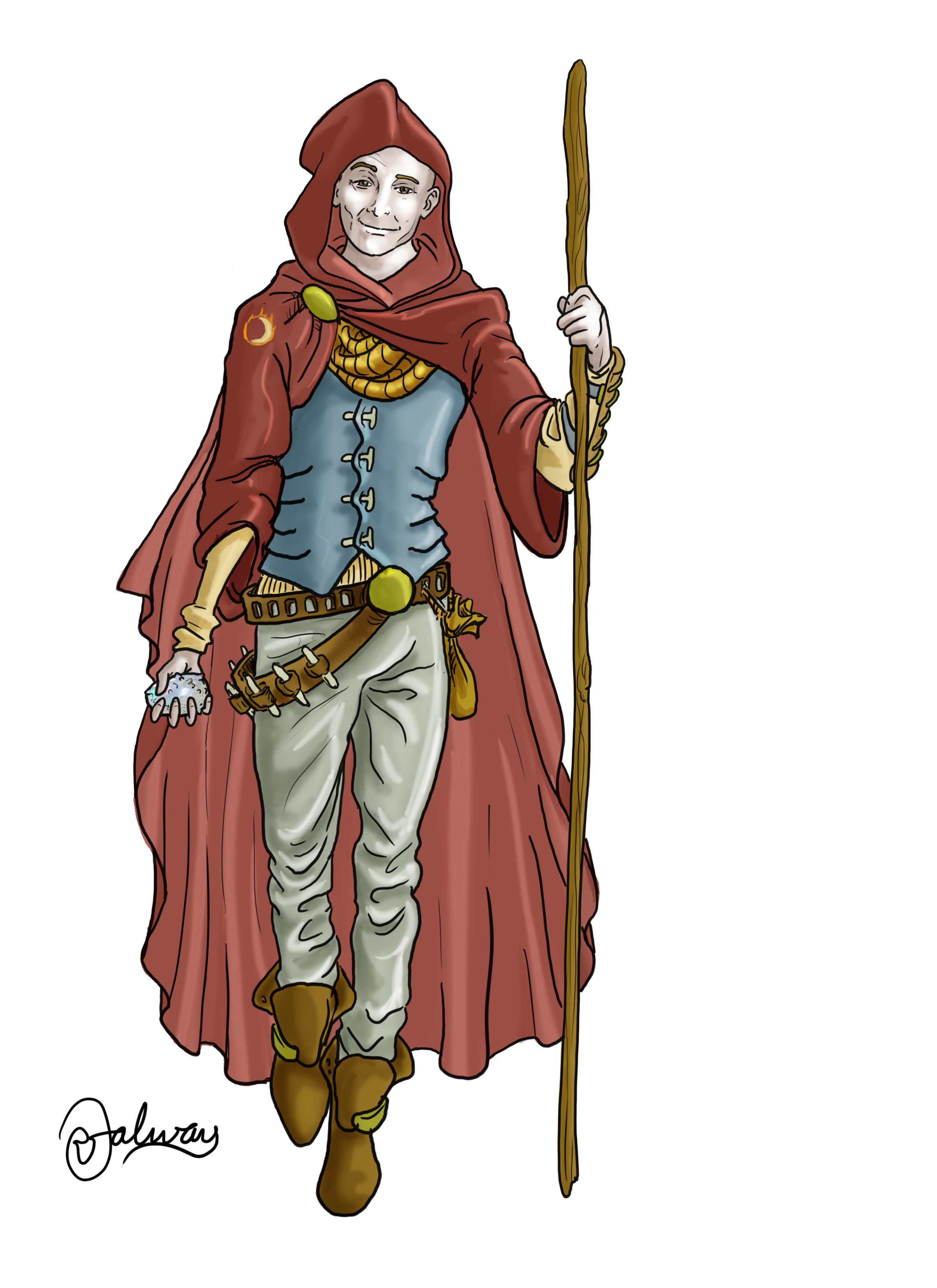
Shon
Art by Ryan Salway
 Enemies of Creed